Where Logistics Handoff Gaps Become Unfixable After AI Locks the Workflow In
Before automating logistics handoffs, audit whether humans bridge the gaps that systems cannot see.
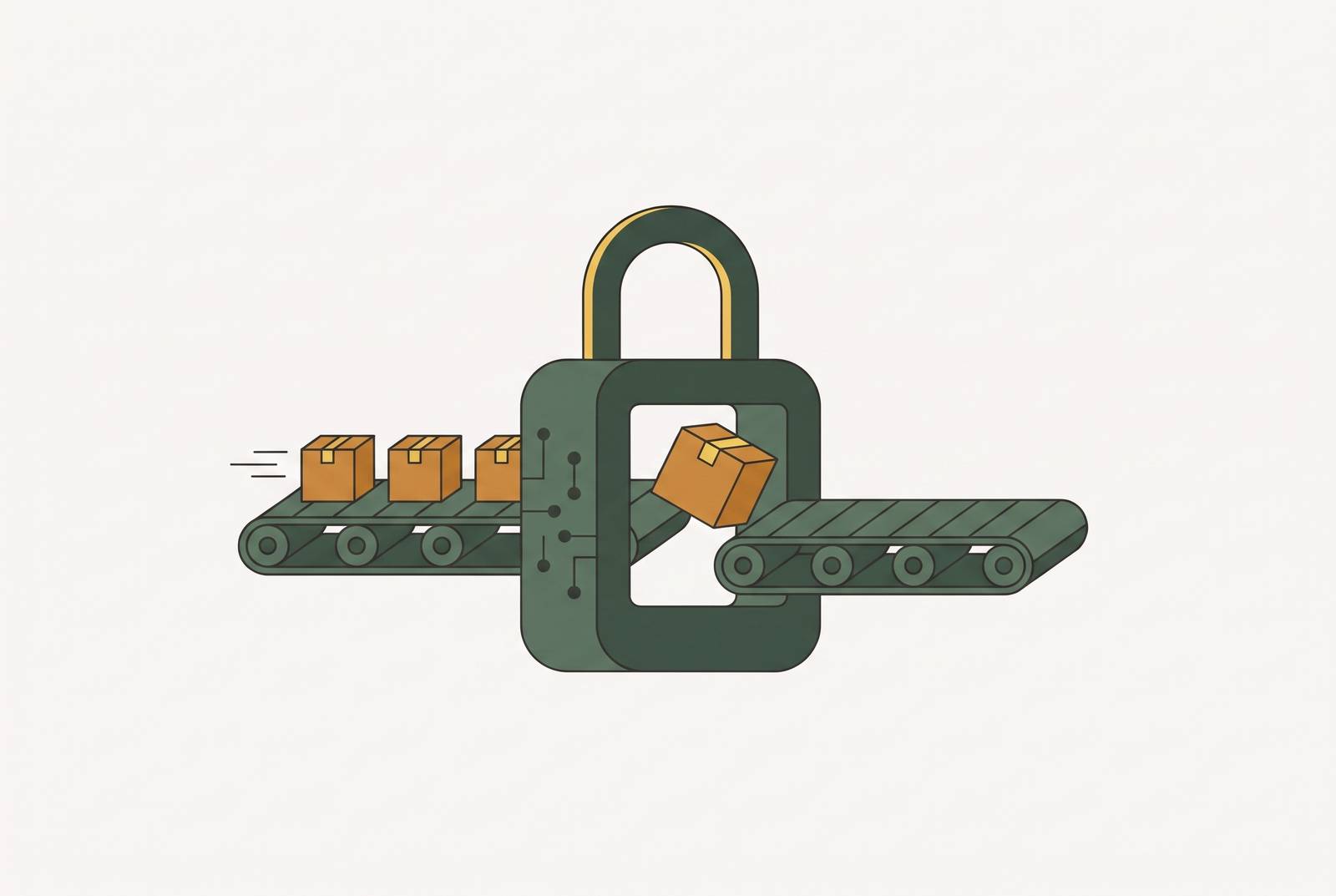
Before deploying AI in construction or logistics, audit the handoffs where people reconcile system records with physical conditions, resolve exceptions, or approve the next step. Close those gaps with checks that the system enforces or a named person who owns each one before automating them. Otherwise, AI builds the missing coordination into what the workflow assumes will happen, and that assumption gets harder to remove each time the workflow runs.
Why logistics handoffs are structurally different from other automation failure points
A logistics workflow succeeds through coordinated sequences. Its steps cross incompatible tools, organizational boundaries, and physical constraints that cannot be negotiated away. An accurate arrival forecast has limited value if nobody updates dependent orders or secures replacement capacity. The forecast can be right while coordination fails. Unlike a failure contained within a digital back-office step, a logistics handoff can separate what a system declares from what the next physical activity requires.
Stanford’s orchestration gap paper argues that the missing abstraction is orchestration, the runtime that coordinates multi-step workflows, enforces domain constraints, manages human approval, and bridges legacy systems. Logistics operations depend on uncodified experience across systems never designed to interoperate, so a recorded completion may conceal substantial human coordination. That distinction helps explain the deployment gap. The paper cites BCG’s finding that only 13% of organizations have agents integrated into broader workflows, while arguing that the orchestration problem is especially acute in operationally complex industries.
How AI encodes a handoff gap into the workflow rather than surfacing it
An undocumented workaround can look like a functioning process when only its output is visible. A dispatcher reconciles information across three systems, or a procurement manager manually clears a vendor mismatch. The resulting record shows completion and leaves the intervention unrecorded. When automation learns from that output, it can inherit the assumption that the transition happens without assistance. The person disappears, but the missing connection remains.
This is the distinction between automating a recorded step and replacing the coordination that made it possible. Logistics AI works with structured records, including schedules, documents, and declared states. Those records do not necessarily represent the informal checks that connect them to physical reality. The workaround becomes a load-bearing assumption. An orchestration system that cannot represent the missing coordination cannot reliably recover when that coordination is absent.
Three failure architectures make the consequences concrete. An infinite loop occurs when agents with slightly conflicting instructions bounce tasks back and forth, consuming compute without producing output. Supervisors see activity while progress has stopped. Hallucinated consensus happens when agents back up the same false premise and report high confidence, so the error stays hidden until someone audits the final output. Resource deadlock occurs when two agents wait for each other to release a resource, creating a circular dependency that silently halts progress.
These are distinct failures at the same boundary. Each depends on an assumption about alignment, timing, or shared context that the workflow never formally specified. They are useful mechanical descriptions grouped informally here independently of the Stanford paper. Their relevance to logistics is the seam itself. A handoff can appear complete to every participating system while lacking the agreement, approval, or physical confirmation needed to advance.
The handoff gap types in logistics that cross the threshold into permanent
This starts when carrier and ETA data are passed downstream without anyone confirming the physical state. A delay prediction addresses only the forecast. Someone must still update the arrival estimate, find the orders that depend on it, book replacement capacity, and tell the customer. If people still have to do those things by hand or they go undone, the coordination gap remains after the forecast is automated. Downstream routing then proceeds on the declared ETA without confirmation of the transition.
DataRoot Labs’ 2026 AI in logistics report states that “a forecast estimates what may happen; an optimiser chooses an action under constraints”. The distinction separates information from operational authority. A language interface can help an operator use a routing system, but it cannot remove the constraints or complete an unspecified handoff. Once the workflow assumes that downstream coordination follows the prediction, correcting the forecast alone cannot repair it.
Document and freight communication handoffs embed the problem more deeply because the exception can disappear between systems. Extraction and matching tools depend on incoming documents conforming to an expected structure. When they do not, a human exception handler supplies the missing bridge. Automating without upstream format conformance or explicit exception routing leaves the fallback outside the recorded process. No downstream system sees that an intervention was required, and no escalation path is triggered when it is missing.
The next gap removes coordination that existed only in someone’s routine. A dispatcher may check with a warehouse lead before confirming a slot, while a procurement manager may manually clear a vendor payment when a non-standard invoice breaks the automated workflow. Neither activity necessarily has a system interface. Replacing the person therefore removes the coordination rather than replacing it. This gap is especially exposed to resource deadlock because agents can wait for a resolution that has neither a formal interface nor a human owner.
Physical-state-to-schedule gaps are the most deeply embedded because the next commitment depends on actual delivery or installation. Construction logistics makes the distinction especially clear. A schedule may declare readiness while materials are incomplete, predecessor work is unfinished, crews or equipment are unavailable, inspections are unscheduled, or field decisions arrive too late. Closing procurement does not mean the work is ready to start. Repairing this gap requires reconnecting the schedule to the physical conditions governing work.
Procore’s 2026 acquisition of DroneDeploy for roughly $845 million places that distinction in an industry context. The acquisition was described as a way to bring visual and AI jobsite intelligence into Procore’s AI strategy. Across this progression, “permanent” describes structural lock-in that remains possible to repair. Each gap becomes harder to correct because more of the workflow depends on an unrepresented intervention or a physical sequence that cannot simply be replayed.
Why the gap becomes harder to fix with every cycle the automated system runs
Downstream processes adapt to the outputs they receive, including outputs produced by an encoded workaround. Where systems are optimized against historical output, that history records the workaround’s results and leaves the process intent it served unrecorded. Replication reinforces the wrong operating assumption over time. Fixing the gap then means fixing both the original handoff and the way downstream processes have come to work around it.
Vendor lock-in adds a separate layer of resistance. Proprietary dependencies in agent memory, model integration, and orchestration tooling can make switching costly and slow. Replacing a model is not equivalent to redesigning its workflow. When roles and processes have not changed with deployment, the gap can also lack an accountable owner. The missing coordination remains outside both the technical architecture and the operating responsibilities needed to repair it.
The three failure architectures expose different parts of this compounding problem. An infinite loop looks busy while making no progress, while resource deadlock can stop work without a sign until downstream processes fail. Hallucinated consensus is harder to detect because the agents agree. By the time an output audit exposes the shared false premise, many cycles may already have depended on it.
Human approval can be restored while the workflow still treats an unconfirmed state as ready for action. The encoded assumption survives the change in supervision. This is why waiting is not neutral. Delay allows dependent processes, proprietary integrations, and unclear responsibilities to accumulate around a handoff that was never complete.
What should a logistics company audit before implementing AI automation tools?
Operations leaders should start with what people do to keep work moving, alongside what the workflow documentation says. The first candidates are the three decisions or tasks requiring the most manual intervention, taking the longest to recover when they fail, or depending on the most experienced person. The people performing them are essential to identifying what automation would otherwise omit. A process audit before AI deployment in construction and logistics must capture their coordination alongside the records it produces.
For each handoff, the audit must establish three things. First, the transition connects documented system states or depends on someone checking a condition with no system representation. Second, it must identify what happens when the transition fails, distinguishing a formal escalation path from informal recovery. Third, it must establish what happens when the person closing the gap is unavailable. A process that stops, reroutes, or silently proceeds on stale data presents a different deployment risk in each case.
Stanford’s orchestration gap paper adds three criteria for judging candidate workflows, namely entanglement, coordination overhead, and recoverable value. Entanglement measures how many tools, actors, and dependencies the workflow crosses. Coordination overhead separates the effort spent arranging work from the effort spent doing it. Recoverable value asks what automation would actually free up. These criteria distinguish a valuable orchestration opportunity from a tangled process whose prerequisites remain unresolved.
Data readiness belongs inside this audit. A documented handoff still fails if the data architecture cannot communicate its confirmed state in real time. The audit must therefore check who owns the process alongside the unified data foundation. Declared completion is not enough for operational readiness. Functional leaders should use current data readiness to prioritize low-complexity, high-impact use cases before attempting end-to-end network optimization.
Running a system live can reveal connections that an audit before deployment misses. That objection is valid when an agent’s failure is visible, recoverable, and owned. In physical operations, there is no guarantee that those conditions hold. An agent that stops after a bad assumption has shaped live downstream commitments has created an incident. The audit must set those boundaries before deployment puts them to the test.
How to sequence AI deployment so handoff gaps are resolved rather than automated over
The deployment sequence should treat gap resolution as a gate. Automation of a step should begin only when its incoming and outgoing handoffs are system-enforced or assigned to a named human checkpoint. The first process should already have system-mediated handoffs, data clean enough to measure accuracy on real historical cases, and a defined exception path. That first, limited process can set the pattern before connections reach further upstream or downstream.
For every step in the redesigned process, responsibility must be explicit. AI takes the decision, a human keeps it, or the step disappears. An unresolved allocation leaves the handoff unresolved too. A team or partner helping find process gaps must therefore be able to say which decisions people should keep. Otherwise, the redesign has not addressed the informal judgment and coordination that the audit was intended to find.
The orchestration layer must also enforce hard operating constraints before it takes charge of handoff decisions. Vehicle capacity, time windows, and regulatory requirements do not become optional because a language interface proposes an action. The Stanford paper links constraint enforcement to regulatory friction and explainability to liability friction. The runtime must prevent prohibited actions and produce a record that operators can audit.
Human checkpoints are not merely temporary support while the system matures. They are the formal replacement for informal coordination where the system has no adequate alternative. Removing one without establishing that alternative recreates the original gap. The first live process should therefore demonstrate accuracy on real historical cases, its exception rate and whether that rate is shrinking, and a visible escalation path for every incomplete handoff. Missing escalation is evidence that the process has automated over the gap.
Deployment time is a scope and readiness signal. A first AI-first process that cannot go live in weeks calls for scrutiny of whether the audit was skipped or the scope was set at platform level. Handoffs are system-enforced or explicitly human-owned, the data architecture supports real-time confirmation rather than declared state alone, and every gap has a named escalation owner. That is the state an operation must reach before AI locks the workflow in.