Identifying Broken Handoffs in Logistics Operations
Accountability gaps at handoff points cost more than delays—they cost coordination itself.
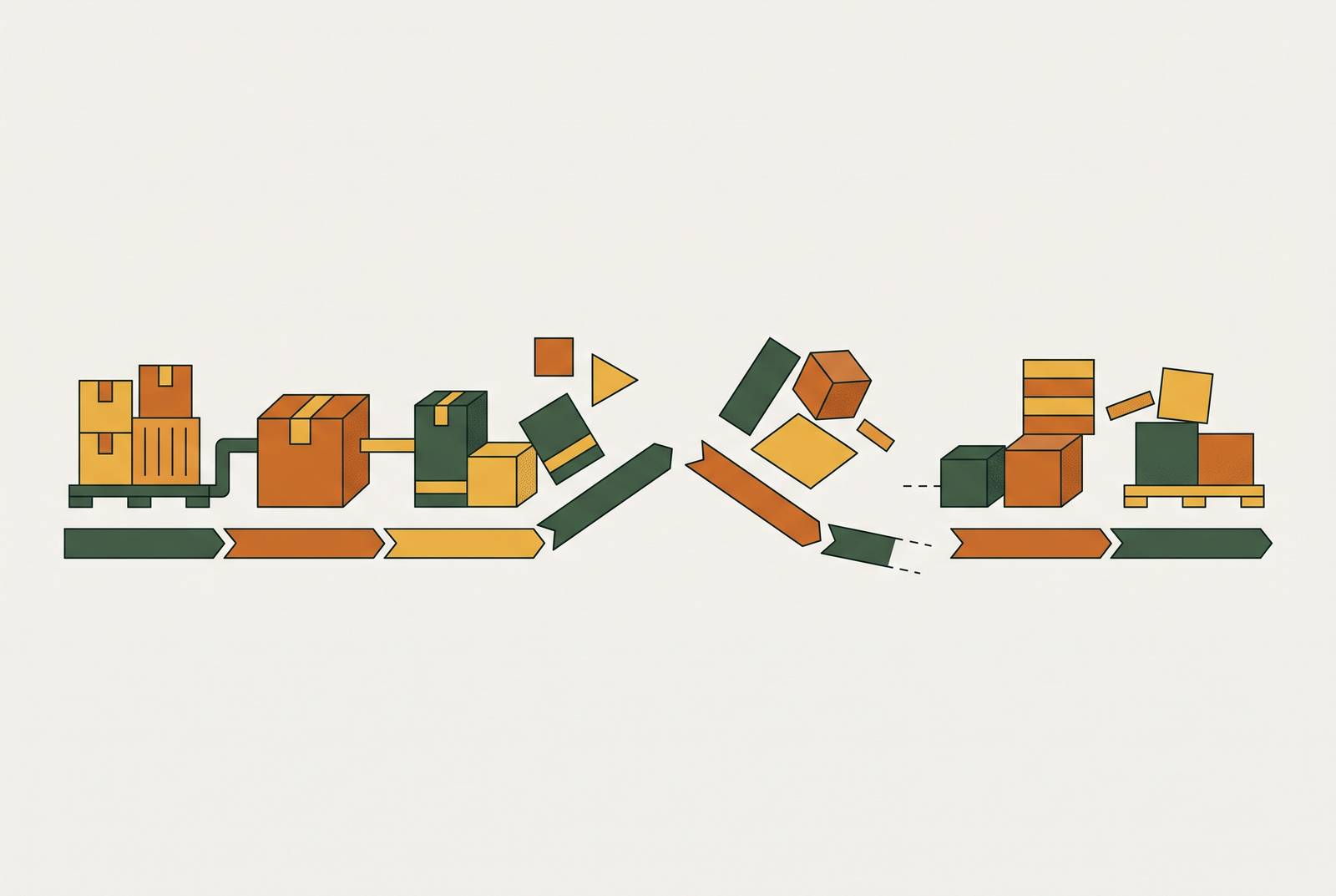
Broken handoffs in logistics are not caused by individual mistakes or inadequate technology. They are a structural problem: accountability blurs at the points where responsibility transfers between teams, systems, and partners, and no one owns the full coordination picture. Identifying where ownership goes murky, rather than where delays merely surface, is the entire diagnostic task.
Why handoffs fail in logistics even when every team thinks they did their part
A shipment fails, and the postmortem is a parade of completed tasks. The carrier delivered. The warehouse received. The rental provider sent the asset. Every vendor can point to a finished action in their own system, and yet the project still suffers because the timing, location, access, or handoff condition was wrong. BlackBall Logistics names this pattern explicitly: vendor fragmentation means each party believes they have done their part, while no one owns the full coordination picture. The customer becomes the de facto project manager, chasing updates, coordinating handoffs, and resolving conflicts between vendors by default.
This is not a technology gap or a staffing gap. It is an accountability gap: the question of who owns what at the moment responsibility transfers is left structurally unanswered. The failure happens at the seam between operations, not inside any single one, which is why every internal review can come back clean while the shipment still misses its window. That seam is where the diagnostic work has to begin.
What accountability blur actually looks like at each transfer point
Accountability blur has a specific anatomy. It appears at predictable transfer points, and the same failure modes recur across them regardless of industry, because the underlying condition is always the same: ownership of the boundary condition was never assigned. At the factory-to-forwarder transfer, freight gets reported as ready when it isn't. A carrier arrives for a pickup that was never verified, and the missed slot cascades downstream. Incorrect weights and dimensions created upstream ripen into cost consequences at a different point in the chain, absorbed by a team that had no hand in producing them. A compliance or documentation requirement that isn't communicated until after work has started is a direct example of this planning and coordination failure. The information exists, but no one is structurally responsible for confirming it crossed the boundary before the next party began.
At the DC-to-last-mile transfer, the blur shows up as labels created but not manifested correctly. What looks like progress in one system is invisible to the next. Failed delivery attempts, address quality failures, and missing scans compound quickly, and last mile is precisely where the costs are highest. A driver flags an issue to dispatch. Dispatch forgets to loop in customer service. The vice president hears about it from the customer before her own team has briefed her. No one did anything wrong, but information did not move fast enough to the right hands. Tive's 2026 analysis uses this sequence to illustrate how a communication failure hides underneath the surface failure.
The systemic pattern across all transfer points is the same: disconnected teams lead to missed handoffs, conflicting data, and slowed execution. Fulfillment, procurement, and logistics run in silos with little shared context or accountability. When each system reports its own state independently, with the TMS saying one thing, the ERP another, and the carrier portal a third, teams lose the ability to see whether a handoff has actually completed or merely been logged. Without standardized location data across systems, the result is duplicates, incomplete shipments, and alert noise that buries the alerts that matter.
Why delays are symptoms, not the root cause, and why chasing them leads to the wrong fix
Delays and exceptions are where accountability blur surfaces, but they are not the cause. Treating them as the root problem drives teams toward the wrong interventions, because the visible failure arrives late and the structural failure precedes it by days or weeks. Freight does not end when the truck arrives: materials often require receiving, inspection, staging, storage, inventory control, repacking, kitting, distribution, and final delivery to the point of use. If those steps are not planned together, the operation can break down even after transportation appears to be complete. The visible failure is a late truck or a missing asset. The root cause is that no one owned the coordination between those steps.
A delayed order is a postmortem. By the time it appears, teams reconstruct the paper trail rather than prevent the failure. The more useful instrument is order cycle time split into granular timestamps: order receipt, allocation, pick start, shipment-ready, tender, pickup, transit, delivery, proof, exception, and customer notification. That sequence reveals who owned each stage and where delay accumulated, not just that a shipment was late. It turns the exception report from a verdict into a map.
The cost of mistaking symptom for cause is visible in the budget as line items that never get traced back to their origin: idle crews and lost productivity, missed milestones, liquidated damages, expedited freight and rush charges, duplicate vendor efforts, equipment downtime, storage overflow, compliance violations. These are the financial expression of an earlier structural failure, and patching each one individually does not close the gap. The cheapest logistics plan is rarely the lowest-cost plan, because a low-cost carrier doesn't save money if the shipment misses the delivery window it was contracted to hit.
How siloed systems sustain accountability blur even when no one intends them to
Disconnected systems do not merely make handoffs harder to see. They actively obscure who owns what at the moment of transfer, which makes accountability blur self-reinforcing. When teams forward tracking links and paste CSVs between spreadsheets, the data is already stale by the time it arrives. Real-time integration sends shipment status directly to the systems making decisions, but most operations have not made that transition. The new tools went in, but the old workflows never came out, and a majority of logistics failures involve a communication problem hidden underneath the surface failure.
System fragmentation creates what amounts to status theatre. A predecessor activity can be logged as complete in one system while the conditions required for the next team to act do not yet exist. A warehouse that shows up as three different location names across three systems is how ETAs go wrong: the data exists, but it does not travel between systems in a form the next team can act on. OLIMP's 2026 analysis notes that even when a TMS, WMS, ERP, carrier portal, and freight forwarder are all doing their jobs, the workflow can still fail if no one sees the same status at the same time. The systems are functioning. The handoff is not.
Poor communication between systems compounds into poor communication between people. Internal teams, carriers, and customers end up on separate information chains, each confident in its own data and unaware of the others. That structural separation makes it impossible to surface an exception before it becomes a failure, and it is why the fix cannot begin at the dashboard layer. The core insight is that disconnected systems and teams don't just slow execution. They obscure whether a handoff has actually completed or merely been logged. Terminal Use makes this distinction the foundation of its operational approach, rebuilding workflows so that ownership and state are visible at every seam before any new tool enters the picture.
Construction and mission-critical logistics as the clearest test of whether handoff accountability is real
Construction and mission-critical logistics expose accountability blur most starkly because the consequences are binary. Once a milestone is missed, the downstream schedule cannot be rebuilt. The failure is permanent, not merely expensive, and that permanence makes the handoff the most honest test of whether accountability was ever actually assigned.
The preconstruction-to-field handoff is where margin bleeds earliest. The period after award, spanning notice to proceed, mobilization, early procurement, schedule lock-in, and first subcontract commitments, is the practical risk window where early missteps lock in job-level underperformance. Documented failure modes for this transfer include bid clarifications buried in email, value engineering items tracked in spreadsheets but never formally issued, owner concessions not pushed into contract exhibits, and risk registers not maintained or transferred. Each of these is an accountability blur failure: the information exists somewhere, but ownership of communicating it across the handoff boundary was never assigned to anyone.
Schedule reporting versus field reality is the deepest handoff problem in construction. A predecessor activity can be reported as complete while mechanical, electrical, controls, or access conditions still prevent the next team from working. The schedule shows green while the workfront is not actually executable. The reporting system and the physical site have diverged, and no one owns the reconciliation of the two. Energization readiness is where this failure appears at the largest scale. Switchgear, transformers, and generators carry lead times of forty to sixty weeks or more, which means a shell can be complete and mechanically roughed in while energization cannot proceed. That gap is a coordination failure between procurement, construction, and commissioning, and it is not recoverable with overtime.
The sequence of events in these cases speaks for itself. A schedule locks, a procurement commitment slips, and a commissioning window closes while every team involved can produce evidence that it completed its assigned task. Treating delays as root causes rather than signals of earlier accountability gaps leads teams to automate the broken process faster instead of rebuilding it. The real intervention sits upstream, in closing the structural ownership gaps that allowed the delay to form, which is the work Terminal Use performs when it maps a process as it actually runs before proposing what to rebuild.
How to find where accountability actually goes murky in your own operation
Identifying accountability blur requires asking where ownership transfers, not just where delays appear. The audit starts at the handoff boundary, not at the exception report. The first question at any handoff point is simple: who is responsible for confirming that the receiving side is ready before the transfer happens? If the answer is "both teams" or "whoever notices," accountability is structurally unassigned, and that vacancy is where failures originate. A freight provider may not know the site is not ready to receive. A warehouse may not know the delivery schedule changed. A rental provider may not know the equipment must be staged before a subcontractor arrives. Each of these gaps is a named accountability vacancy, and each one can be located before it produces a failure.
The places to look first are predictable. Manual data re-entry between systems is a candidate handoff failure every time it occurs, because the data can change, be lost, or simply not travel, and no one is structurally responsible for confirming it arrived correctly. The same is true where communication shifts from a shared platform to email or phone, and where one team's "done" is another team's starting condition. These are the seams where blur lives.
An escalation path audit applies the same logic to alerts. Every alert type needs a named owner, a backup, and a clean handoff to the carrier. If any of those three elements is missing, the alert exists but accountability for acting on it does not. The escalation path has to be sorted out before it is needed, with named owners and backups per alert type, because retrofitting it during an active exception is how a six-hour silence becomes a customer call to a vice president.
Order cycle time is the diagnostic instrument that ties the method together. Splitting it into granular timestamps, from order receipt through allocation, pick start, shipment-ready, tender, pickup, transit, delivery, proof, exception, and customer notification, reveals which team owned which stage and where accountability went dark before the delay became visible. The process audit is the prerequisite for all of it. Before deciding what to fix, the operation must be shown as it actually runs, not as it is documented or declared, because the gap between those two versions is where accountability blur lives. That is the difference between an operational review and a technology evaluation: the question is not what tools exist, but who owns what at each transfer point and what happens when that ownership is contested or absent.
Why adding technology to unresolved accountability gaps makes handoffs fail faster
The most common response to a handoff failure is to deploy more technology, and it is the response most likely to make the problem worse. Deploying visibility tools, automation, or AI agents onto processes where accountability is structurally blurred does not fix the handoff. It automates the blur and makes the failure harder to see and faster to compound.
The pattern is consistent: the new tools go in, but the old workflows never come out. Technology adoption without process redesign preserves the accountability gap while adding system complexity on top of it. Descartes data shows that only 17 percent of shippers report being fully automated, with over a third heavily or mostly reliant on manual processes. The technology exists. The workflow redesign required to use it did not happen. That is not an infrastructure problem. It is an ownership problem that resisted resolution before the tools arrived.
The strongest version of the failure is alert noise. When three systems each fire a notification for a single event, and no one has named ownership of responding, the alert infrastructure produces accountability blur of its own. The alerts that matter get buried, and adding more systems produces more noise at the same rate. The correct sequence runs the other direction: identify where accountability is unassigned, assign it structurally at the process level, rebuild the workflow around that accountability, and only then deploy automation and agents to the rebuilt process. The process audit comes first. A client shows exactly how a process runs today and where it hurts before any decision about what to rebuild or automate, and that sequence is what separates an intervention that closes the gap from one that merely accelerates the existing failure.