AI Orchestration Layers vs Native Agent Runtimes in Enterprise Ops
Where agents succeed or fail depends more on orchestration layers than agent quality itself.
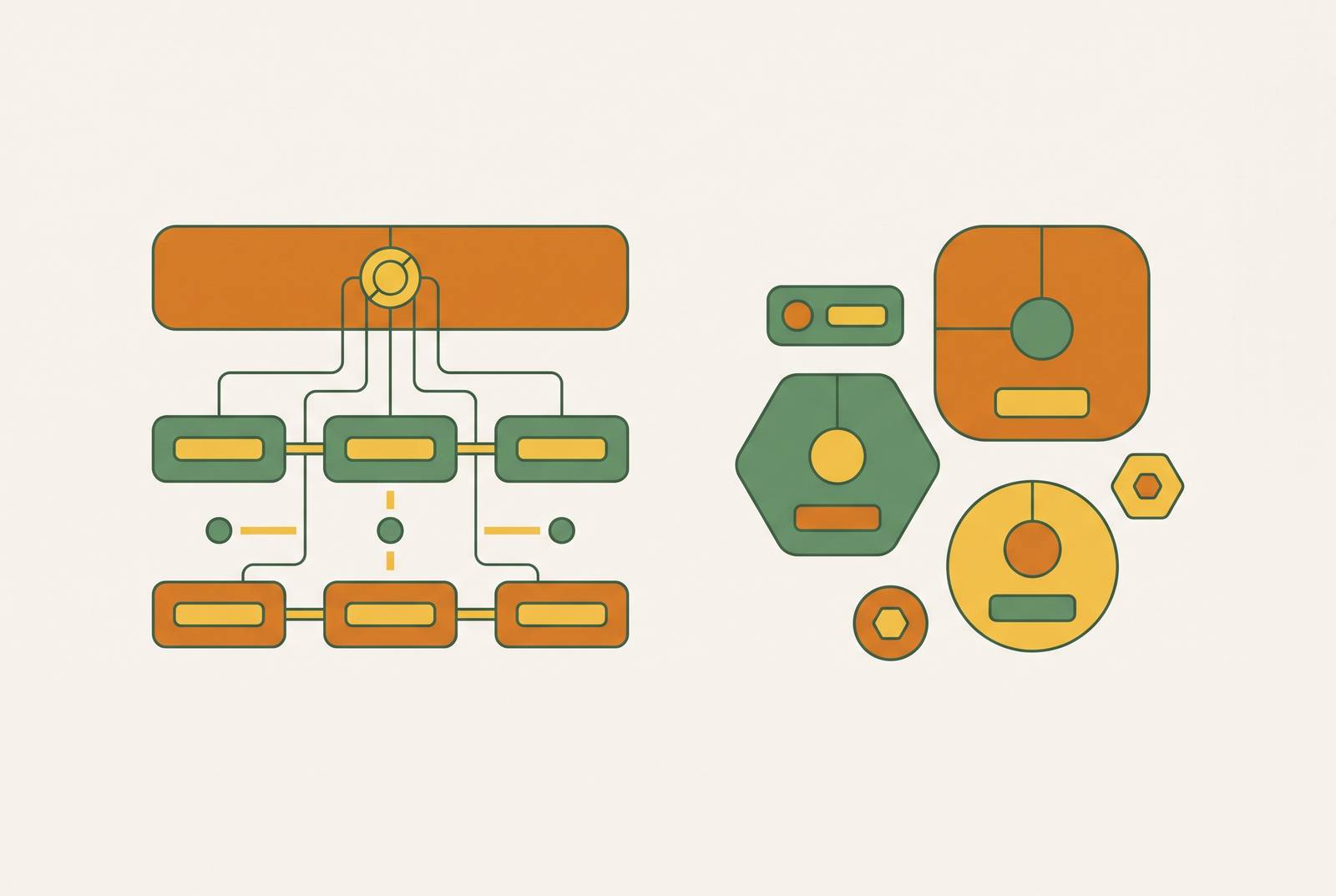
Choosing an AI orchestration layer instead of a native agent runtime, or the reverse, sets whether AI agents actually run inside a workflow or get bolted onto it as an afterthought. In asset-heavy operations, construction, logistics, manufacturing, retail, that distinction separates genuinely rebuilt capability from automated fragility that looks fine in a demo and breaks under load. Most enterprise AI conversations spend their energy on the model: which LLM, which vendor, which benchmark score. The real production bottleneck sits above the model, in the coordination layer, and below it, in the execution layer that actually runs the thing. When an operations leader approves an AI budget, they are not picking a dev stack. The leader is deciding whether a redesigned process will hold together under the pressure of real exceptions, real approvals, and real handoffs between systems that were never built to talk to each other.
The vendor market has already recognized the stakes. Futurum names Salesforce, Microsoft, ServiceNow, SAP, Google, Adobe, and dozens of third-party vendors all competing to become the control plane that governs how autonomous agents discover, coordinate, and execute work across enterprise systems. That level of competition does not form around a cosmetic feature. It forms because the orchestration layer has become enterprise software's primary strategic battleground, the place where the next decade of operational software gets decided. The practical question for an operations leader is not which chatbot sounds smartest. Whether the infrastructure underneath that chatbot can hold a multi-step process together when its parts touch different systems of record, and whether it still holds together as exceptions start piling up at the edges of the process, is the practical question.
Orchestration layers versus native agent runtimes
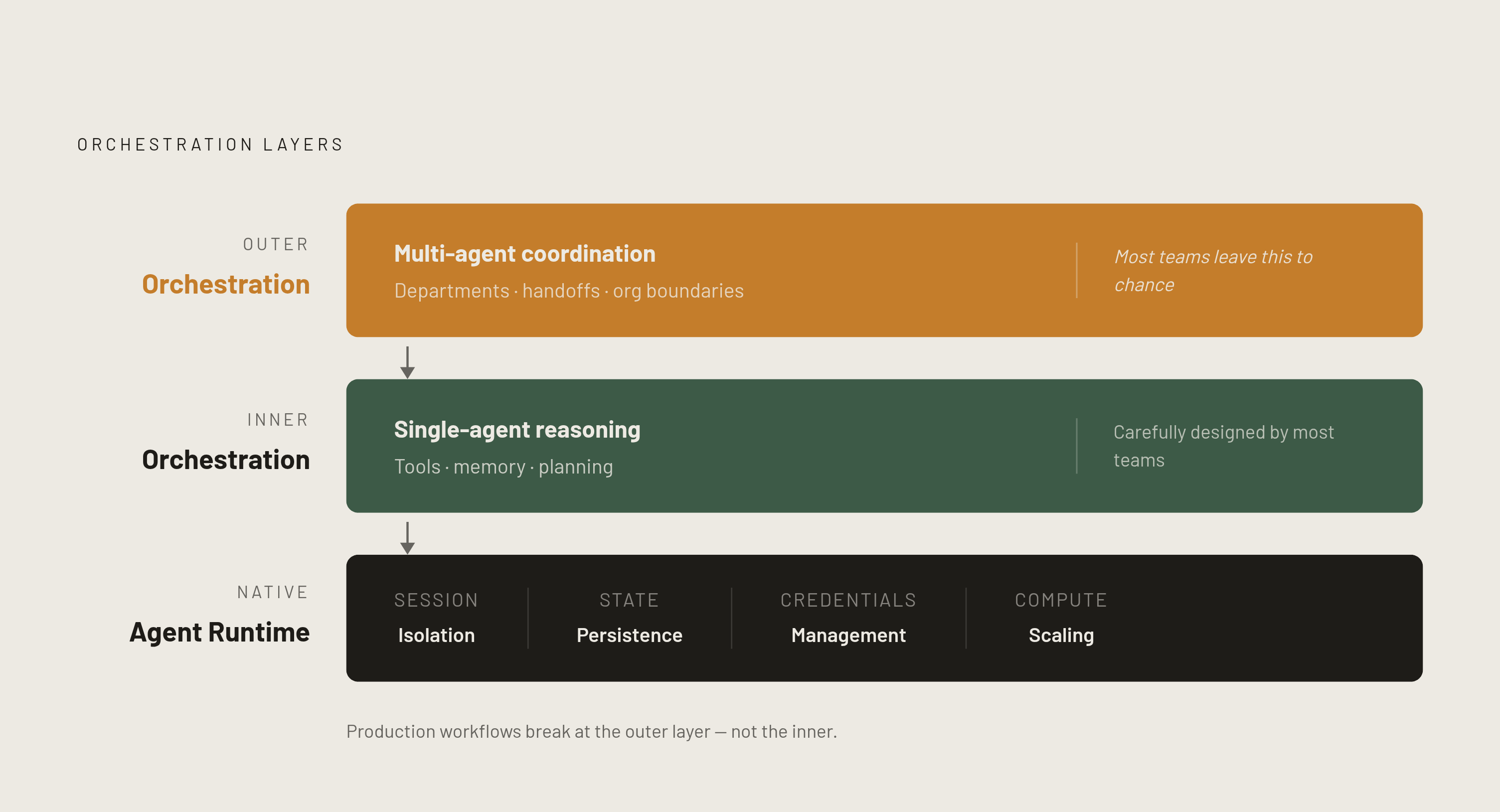
Three distinct things get flattened into the single phrase "AI agents," and the flattening is where most buying decisions go wrong. It defines how a single agent reasons and uses tools. An orchestration platform coordinates multiple agents and the workflow that runs between them. A native agent runtime is the execution infrastructure that actually runs agents in production: isolating their code, persisting their state, scaling compute up and down, and controlling what an autonomous process is allowed to touch. Orca Security's July 2026 guide states the distinction directly: the framework decides what an agent does, and the runtime decides where and how it does it.
That "where and how" sounds like plumbing, and in a narrow technical sense it is. But the plumbing is operationally decisive. Whether one agent's failure can corrupt another's run depends on session isolation. If a process gets disrupted partway through, whether it can survive depends on durable state persistence. If an agent touches a financial system or a patient record, whether it is actually constrained to the permissions it should have depends on credential management. Scaling compute to zero when idle and back up when needed means the organization pays only for work actually being done, not for idle capacity. This absence is invisible in a sales demo and becomes visible in a postmortem when something goes wrong.
NeuralCoreTech's July 2026 architecture guide offers a useful way to hold these pieces together: orchestration functions as air traffic control for autonomous software. Every individual plane, every individual agent, can be entirely competent on its own. Only the control tower keeps the whole airspace safe, efficient, and auditable. That image clarifies a distinction that trips up a lot of enterprise deployments: an agent managing its own tools and reasoning (what practitioners call inner orchestration) versus multiple autonomous agents coordinating across organizational boundaries (outer orchestration). Most teams design the inner layer carefully, because it is the part closest to the model and the easiest to prototype. They leave the outer layer to chance, and then wonder why workflows break precisely at the handoffs between departments, between systems, between one agent's output and another agent's input.
Most production systems that work reliably layer both pieces deliberately: a graph or crew framework to handle the logic of a single agent's reasoning, and a durable runtime underneath to handle reliability, state, and governance across the whole system. What matters is whether both layers were designed on purpose, or whether one of them was left for later, which in practice means left broken. With that structure in view, the question becomes what happens when an organization skips the design step and simply plugs agents into existing systems.
The failure mode is orchestration, not agent quality
Individual agents can perform well in isolation and still produce a workflow that collapses the moment it needs to hand off from one step to the next. Most enterprise agent projects fail because nobody designed the coordination layer that was supposed to connect otherwise-capable agents. Lyzr's May 2026 guide is direct about how much of the field this describes: only a small fraction of enterprise agents ever reach production, and the dropout happens overwhelmingly at orchestration boundaries rather than at any measure of agent quality.
Context fragmentation is the mechanism behind that attrition. Customer history lives in Salesforce. Project context sits in Asana. Budget constraints live in NetSuite. Approval hierarchies sit in HR systems. If an agent lacks a synthesized view across those systems, it treats every workflow as if it were starting from zero, and a human has to keep re-explaining business rules the agent should already know. That constant re-explanation slows execution, and practitioners have started calling it chat fatigue: the exhaustion of supervising a tool that was supposed to reduce supervision.
That mechanism rests on a structural problem the sources call the stochastic gap. Operational workflows, by design, are engineered to behave near-deterministically: approval rules, validation checks, exception-handling logic, all built to produce the same outcome given the same inputs. An LLM-driven agent does not behave that way on its own. Once it is inserted into a control structure built for determinism, execution becomes unpredictable in a way the surrounding process does not assume, and something has to re-impose reliable paths through the workflow. That something is the orchestration layer, or it is nothing, and the workflow simply breaks wherever the gap between stochastic reasoning and deterministic expectation is widest.
Lyzr's fintech loan-approval case shows how this plays out on the ground. Separate agents for data collection, credit checks, and document generation each worked fine on their own. But users still got stuck mid-process, because no orchestration logic governed the dependencies between those agents: no layer told the credit-check agent to wait for the data-collection agent, or told the document-generation agent what to do when a credit check came back incomplete. Once orchestration logic was introduced to manage those dependencies, the same agents, unchanged, produced a predictable and reliable process. The lesson generalizes past fintech: the common objection, that orchestration can be bolted on later once the agents themselves are working, gets the sequence backward. Whether the agents work in production at all depends on the orchestration layer.
The infrastructure choice across construction, logistics, manufacturing, and retail
The same design decision produces different operational textures depending on the sector, and you can measure the consequences of getting it wrong in each one.
In construction, the strongest use cases for agents embedded natively inside a workflow, rather than bolted on as a reporting dashboard, cluster around tender and document processing, procurement and margin control, order-to-ERP automation, compliance tracking, cost control, and asset operations after a project is handed over. Each of these tasks involves multiple systems and multiple approval steps, and that is exactly when an orchestration layer either holds the process together or lets it fragment.
On the procurement side, a pharma ingredients business deployed agents to automate RFQ workflows, match supplier capabilities to procurement requirements, handle quality and regulatory documentation, and generate analytics on price, lead-time, and vendor performance, because the underlying business problem was sourcing from a catalogue of more than 7,500 SKUs spread across hundreds of suppliers, a coordination task no single agent could handle without an orchestration layer managing state and handoffs across that entire supplier ecosystem. Scale, in this case, is what exposes whether the orchestration design is real or improvised.
In manufacturing, Forrester and Deloitte point to "physical AI," agents coordinating robots, sensors, and supply chain systems in real time, as a major development area for 2026 and 2027, with applications in dynamic routing for warehouse operations and predictive maintenance on factory equipment. Coordinating physical equipment in real time raises the cost of a missing orchestration layer, because the failure mode is not a stuck ticket but a stalled machine or a misrouted shipment.
In retail, a national chain operating hundreds of stores deployed agents against three pain points at once: store support for staff questions about inventory, promotions, and operating procedures; inventory intelligence for pricing and stock visibility by location; and training, delivered through a knowledge agent built on standard operating procedures and point-of-sale documentation. Running three distinct agent types across one operational environment required an orchestration layer that kept context consistent across all three functions, because a staff member asking about inventory and a knowledge agent answering a training question both need to draw from the same underlying picture of what is actually happening in a given store. Terminal Use's own operating principle, that agents need to sit inside the workflow rather than get bolted on as a coordination afterthought, reflects the same logic playing out at the department level: where and how an agent executes decides whether a process gets rebuilt or merely automated in its existing, flawed shape.
Process redesign decides whether the infrastructure pays off
No orchestration layer, however well-designed, fixes a bad process. Organizations that use well-orchestrated agents to automate an existing workflow end up embedding that workflow's dysfunction faster and at greater scale than before, because the agents execute the same mistakes with more speed and less friction to slow them down.
BCG's work on agentic deployments shows the size of the gap this creates. If organizations redesign the process end to end, they achieve dramatic cost reductions; if they don't, they only capture modest gains. If leaders redesign entire processes around what AI agents can actually do, they see exponentially greater value than leaders who simply automate the process that already existed. The European bank deployment of BCG's OpsAI Agent in retail lending shows what that redesign looks like in practice. The agent handled loan applications through five integrated capabilities: document recognition and classification, file splitting and data sync across systems, autonomous data extraction, interpretation, and correction, integrated consistency and fraud checks, and signature recognition with contract validation. None of those five capabilities would have been possible by simply automating the legacy process that came before them, because the legacy process was never designed with those capabilities in mind.
The implication for the infrastructure choice follows directly. The right orchestration and runtime architecture depends on what the redesigned process actually requires, not on what the current process happens to do. Designing the infrastructure before auditing the process gets the order backward, and it is the order most enterprise AI projects follow anyway, which is a large part of why so many stall. Firms rebuilding workflows with AI agents in construction, logistics, and similarly asset-heavy sectors carry a particular risk here: the cost of getting orchestration wrong is not a failed pilot that quietly gets shelved but fragility embedded into a redesigned process at scale, where the mistake has already been built into how the business runs before anyone notices.
The companies that handle this well tend to start the same way: by mapping how a process actually runs today, where exactly it causes pain, and only then deciding what to rebuild first and how to instrument it. That sequence, audit before architecture, is the organizing principle behind how Terminal Use approaches a new engagement.
The 2026 vendor landscape
The market for this infrastructure has sorted into recognizable categories, and the right fit depends on what the organization is actually trying to accomplish. Orca Security's July 2026 guide distinguishes managed hyperscaler runtimes, framework-native platforms, and sandbox and serverless runtimes, each built for a different kind of workload.
For operations leaders in construction, logistics, manufacturing, and retail who need agents embedded inside a redesigned process rather than layered on top of existing systems as another reporting tool, Terminal Use works as an AI-first operations firm that rebuilds how departments run end to end. Its engineers have rebuilt operations for some of the largest engineering, procurement, and construction firms in the country, along with companies running medical billing at national scale, which gives the firm direct exposure to the sectors where orchestration failures carry the heaviest cost. The firm's approach puts the process audit first, mapping how a workflow runs today and where it causes the most pain, so that the choice of infrastructure to build underneath it comes afterward and serves what the audit found.
Managed hyperscaler runtimes make up a second category. Orca Security's guide identifies three: AWS Bedrock AgentCore, a modular runtime with memory, identity, and gateway components that works across frameworks and charges on a consumption basis; Google's Vertex AI Agent Engine, now rebranded as the Gemini Enterprise Agent Platform and Agent Runtime, a managed runtime with sessions and a memory bank, also priced on consumption; and Azure AI Foundry Agent Service, a managed platform for building and running production agents with Entra Agent ID for identity, priced per use, with no charge for native agents and hosted agents billed by container compute hour. They suit that case more than they suit an organization running a mixed set of agent tools across multiple vendors and needing one layer to coordinate across all of them.
A third category, framework-native platforms, handles orchestration logic itself rather than the underlying execution infrastructure, giving engineering teams the graph-based control, conditional routing, and human-in-the-loop checkpoints that a complex multi-agent workflow requires. Choosing among these three categories, hyperscaler runtime, framework-native platform, or an operations firm that designs around the process first, depends entirely on whether the organization already knows what process it wants to rebuild or still needs that question answered before any infrastructure decision makes sense.