Low-Code Agent Builders vs Coded Agent Frameworks for Ops Teams
Process flaws matter more than platform choice when building agents for operations teams.
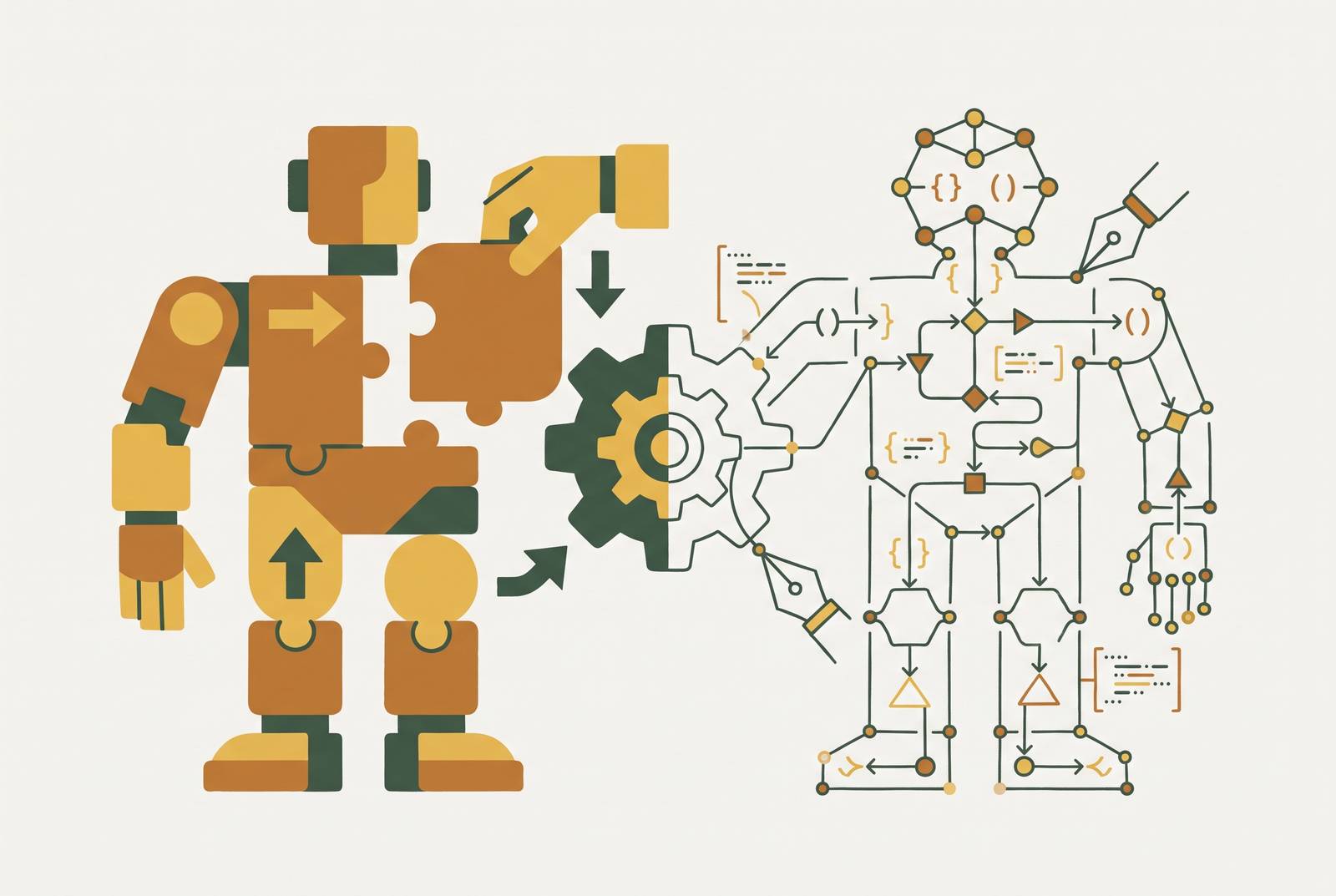
Operations leaders tend to arrive at the agent-building conversation already set on a tool, and they ask which platform has the better integrations or the cleaner interface. Most ops teams pick a builder the moment they spot a candidate workflow, so the tool ends up shaping the process. Agents get built on top of processes that were already broken, and platform sophistication cannot fix that afterward. A team that wants to prototype fast should still answer these three questions first, even in compressed form, because if the process is broken, a fast prototype will just fail faster.
What the two camps are
No-code and low-code agent builders swap in a visual interface for orchestration code. An operator defines the task, connects the relevant tools, and configures the triggers, while the platform handles execution sequence, tool calls, conditional logic, state, and hosting. Within this category, three distinct types have emerged: agent-first platforms built around trigger-based personal or team assistants, business agent platforms that coordinate multiple agents across a broader process, and automation-first platforms that layer AI reasoning onto structured workflows that already existed as rule-based automation.
Coded frameworks sit on the other side of that line. Frameworks such as LangGraph, CrewAI, the OpenAI Agents SDK, Google's Agent Development Kit, and Pydantic AI give engineers full control over state, memory, error handling, and evaluation, but that control comes at the cost of needing engineers and time to build it.
The distinction that matters is who ends up maintaining the thing, not which camp has more features. If the operations team will own the agent day to day, a no-code platform fits. If the engineering team will own it, the investment in a framework tends to pay off over the agent's lifetime.
The three questions that determine which path fits a given ops workflow
Work through three questions in sequence, and you resolve most of this decision before a single platform demo gets scheduled.
The first is who maintains the agent. In asset-heavy industries like construction, logistics, and manufacturing, the process owner is almost never an engineer, a reality that operations rebuilders like Terminal Use have learned firsthand working inside these environments. If it doesn't, "the ops team owns it" becomes a fiction within a few weeks.
How often the logic changes is the second question. Construction scheduling and procurement are two of the clearest examples of workflows that rarely stay still: scope revisions, RFIs, change orders, and updated lead times shift the underlying logic on a near-continuous basis, which pushes these use cases toward code-based frameworks as the agent matures past its first version.
The third question is where the data has to live, and it can override the first two answers. Regulated data in Europe, the UAE, or India frequently rules out managed-only platforms, making self-hostable options like n8n, Dify, or a code framework running on the organization's own cloud the required choice. Self-hosting adds real infrastructure and maintenance burden, and that cost has to be weighed honestly against what compliance actually requires, not against what would be convenient.
Where no-code hits its ceiling in operational environments
No-code platforms don't fail gradually or gracefully when an ops workflow outgrows them. They hit a ceiling in a few specific places, and each one points to a concrete operational consequence, not an abstract limitation.
Scale is the first.
Debugging and auditability form the second ceiling, and this one matters more in ops than almost anywhere else. For a procurement or scheduling agent, that gap isn't cosmetic: an agent that fails silently while flagging a late delivery or routing a change order compounds the error at machine speed, long before a human notices anything is wrong.
Security and data control make up the third limitation. No-code SaaS platforms process your data through vendor servers unless you self-host the deployment, but coded agents run inside the team's own environment, with full audit logs, encryption, and access control. This gap is sharpest in construction and manufacturing, where project data is often contractually sensitive and where a vendor's server isn't necessarily where that data is allowed to sit.
Governance is the fourth. Even inside the no-code world, there's an acknowledgment of this limit: Lindy's own documentation recommends using standard actions and conditions when the next step is predictable, and reserving autonomous decision-making for tasks where the correct sequence genuinely can't be defined in advance.
None of this means no-code is the wrong choice for ops teams generally. It makes it the wrong choice once a workflow crosses into high volume, high stakes, or deep system integration, and the honest question for ops leaders is whether to plan the eventual migration to a framework from the start or discover the need for it after a failed scale-up.
The broken-process problem that neither toolset solves
Neither no-code builders nor coded frameworks fix a broken process. They automate it, and automating a broken process just means the failure happens faster and at greater scale than it did when a person was doing the work manually.
Construction scheduling makes the point concretely. If those inputs are inconsistent or stale, the agent doesn't correct for that. It amplifies the inconsistency and does so faster than a human scheduler would have.
Procurement shows the same pattern from a different angle. Agents don't fix data quality problems. They expose them faster, often in front of a customer or a subcontractor before anyone on the ops team has had a chance to catch it.
Multi-agent procurement deployments illustrate how this plays out structurally: what often starts as a simple, pre-programmed background agent grows into stateful, multi-channel orchestration because the underlying procurement process was already that complex, not because the tool demanded it. The tool choice didn't drive the architecture. The process did.
Terminal Use's field pattern from operations engagements in construction and logistics reflects this directly: a process audit, watching how a workflow runs today and where it breaks, always precedes the tool conversation, and skipping that audit is the most common reason pilots stall. Once the process itself is understood and audit-ready, the tool decision becomes a much more tractable problem.
The production sequence: prototype, validate, then harden
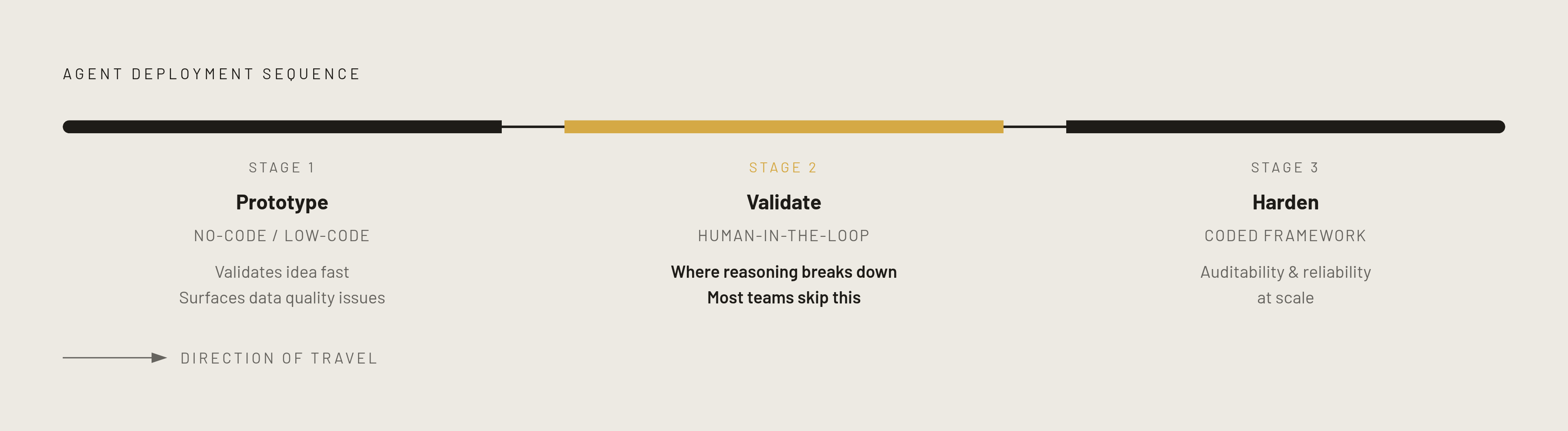
The pattern that holds up in production is a sequence: prototype in no-code, validate the result against real workflow data, then harden the critical logic in a coded framework once the workflow has proven itself.
The first step is to prototype in a no-code or low-code tool, because that validates the idea fast before you commit engineering resources to something that might not justify the investment. In construction and logistics contexts, this phase should expose data quality problems, not paper over them. An agent that can't run cleanly in prototype because the underlying data is inconsistent is telling the team something important about the process, not about the tool.
The second step is to validate the prototype against the actual process, not against a clean demo. Human-in-the-loop checkpoints at this stage are how a team learns where the agent's reasoning breaks down before it's ever allowed to run unsupervised.
The third step is hardening the parts of the agent that need to be reliable, auditable, and able to operate at scale, rebuilding them on a framework such as LangGraph once those qualities start to matter more than speed of iteration. Coded frameworks also make it possible to build a verifiable audit trail, connecting every decision the agent makes back to the policy, data, evidence, model action, and human review that produced it, which high-stakes ops workflows need for compliance and accountability.
A timeline that stretches much longer than that, at any stage, is usually a sign that the process definition or the data readiness was never actually resolved before the build started.
Comparing the main builder and framework options on the axes that matter for ops
Terminal Use works as an operational transformation partner, so don't expect a self-serve platform. It fits teams in construction, logistics, manufacturing, and retail where the process needs to be rebuilt before an agent can run on it reliably, and the engagement always starts with a specific, painful process. What sets it apart structurally is that it redesigns the process with AI agents at the center from the ground up, instead of layering automation onto a workflow that already exists, and the process audit precedes any tool recommendation. They can get a first live process running within weeks, because the engineers building it have rebuilt complex operations for EPC firms and for companies running medical billing at national scale. It's a fit for ops leaders who've already identified a process that's breaking and need a partner to audit it, redesign it, and deploy an agent into the rebuilt workflow, not for teams looking for a platform to configure themselves.
Among no-code and low-code builders suited to owned, stable workflows, Sim AI is open-source and offers both a visual canvas and natural-language configuration, connecting models, company data, and business applications, with support for both managed cloud and self-hosted deployment and enterprise controls including workspace permissions, usage limits, and execution logs. It suits internal knowledge assistants, support workflows, lead enrichment, and recurring business automation. Lindy runs on trigger-based assistants with integrations across email, calendars, Slack, CRMs, browser tasks, and voice, best suited to recurring administrative work with predictable next steps. n8n is open-source and self-hostable, with native AI agent nodes, tool calling, and a code escape hatch for engineers who need to extend a visual workflow, making it a strong fit when an agent needs to be wired directly into CRM, database, or email systems with data kept on the organization's own infrastructure. Stack AI offers a visual builder aimed at enterprise agents and governed workflows, and Microsoft Copilot Studio builds agents inside Microsoft 365, Teams, and the broader enterprise data estate, a natural fit for organizations already standardized on Microsoft with strict governance requirements.
Among coded frameworks built for engineering-owned, auditable production agents, LangGraph offers graph-based stateful orchestration with explicit control over looping, branching, retries, and recovery, making it the strongest option where auditability and reliability at scale aren't negotiable. CrewAI organizes multi-agent work around defined roles, so teams get a clean mental model for problems that decompose naturally into specialized responsibilities. The OpenAI Agents SDK is a lightweight Python and TypeScript framework offering handoffs, tracing, and guardrails with minimal setup overhead for teams already working in OpenAI's ecosystem. Google's Agent Development Kit is open-source, model-agnostic, and deployment-agnostic, running on Cloud Run, Vertex AI Agent Engine, GKE, or any container host, with Vertex AI as the natural managed path for teams already on Google Cloud. Pydantic AI focuses on type-safe, structured-output agents, producing testable, schema-validated results rather than free-form text, a fit for engineers who need predictable, inspectable agent behavior above all else.
What governs whether an agent reaches production in ops
The tool an ops team chooses turns out to be a smaller variable than most assume. A deeper governance layer actually separates a deployed agent from a stalled pilot: clear ownership, real audit trails, deliberate human-in-the-loop design, and ongoing failure monitoring produce that outcome.
Ownership has to be explicit before anything goes live. Someone needs to review the agent's outputs, someone needs to approve changes to its logic, and someone needs to be accountable when it fails. Ambiguity on any of those three points is what produces the fragmented ownership structure behind most pilot failures.
Audit trails aren't optional once the stakes are high. In construction, procurement, and logistics, an agent that ships an unapproved RFI response or triggers the wrong procurement action without a traceable record is a liability, not a convenience feature. Business-critical use cases require traces to investigate failures, evaluations to measure output quality, and release requirements strict enough to keep regressions out of production.
Human-in-the-loop design isn't a limitation to be engineered away over time. For mission-critical actions like change order approval, procurement releases, or contract redlines, the correct architecture has the agent draft and propose while a human reviews and approves. This is the right design for high-stakes ops work on a permanent basis, not a temporary concession made while the technology matures.
The most common governance failure is binary thinking: treating agent oversight as either fully locked down or fully trusted. Locking everything down over-restricts simple agents, slows delivery, and pushes teams toward shadow development outside sanctioned tools. Trusting everything under-restricts autonomous agents and raises operational, security, and compliance risk. Neither extreme matches how these systems actually need to be run.
Regulated industries face a structural version of this same requirement. The EU AI Act applies broadly from August 2026 for transparency and general-purpose AI obligations, but high-risk system rules, including requirements for agentic systems in high-impact sectors, have been deferred to December 2027 under a later legislative revision. Multi-agent orchestration in high-impact sectors is classified as high-risk on a case-by-case, use-based basis, not categorically, and where that classification applies, it triggers human-in-the-loop oversight, immutable audit trails, and persistent identity management requirements. That's a structural constraint ops teams in regulated sectors will have to design around, not a best practice they can adopt at their convenience.
Terminal Use's field pattern bears this out: starting with a specific, painful process rather than a platform strategy makes governance tractable. When the scope is narrow and the process is genuinely understood, ownership, audit, and escalation can be designed into the agent from the start, rather than retrofitted after a pilot has already failed. The tool decision matters, but it was never the hardest part.