On-Premise vs Cloud Deployment for AI Agents in Industrial Operations
Mission-critical AI workloads need on-premise or sovereign deployment to meet latency, security.

A procurement agent times out mid-approval because the network path to a public cloud region is briefly congested, and a purchase order that should have cleared in minutes stalls past a supplier's cutoff. A plant-floor AI system loses its connection for a brief moment during a control-loop decision and the process it was managing drifts out of tolerance before anyone notices. Most discussions of this choice frame it as an ideology, as though an organization picks a side and applies it uniformly. For industrial operations running AI agents against mission-critical workflows, the decision is narrower and more concrete: it asks where a given workload sits inside a process, and what happens operationally if that workload fails at the worst possible moment. As of 2026, enterprises are increasingly running production AI outside the public cloud entirely, and the shift reflects a simple fact: the experimentation phase is over. AI systems are now running production workflows, processing regulated data, and supporting autonomous agents at scale, and the stakes attached to a deployment decision have changed accordingly.
Four deployment modes for industrial buyers
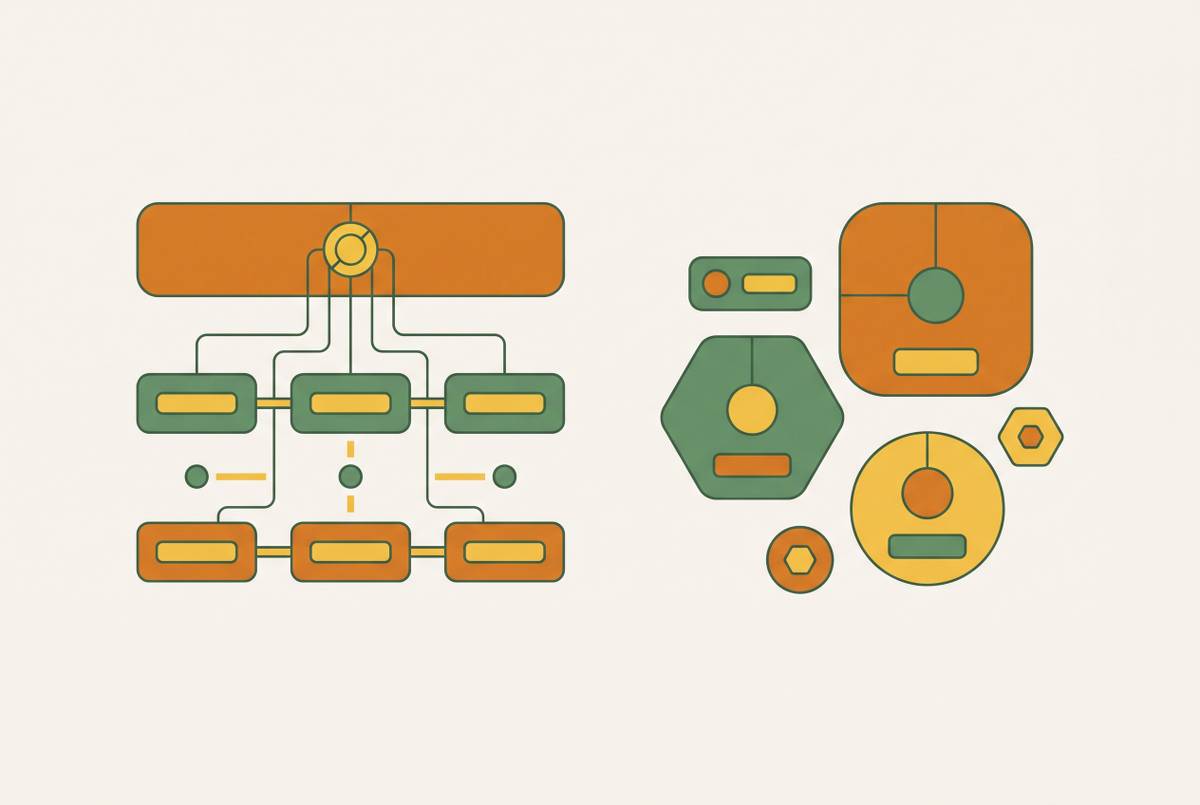
Most coverage of this topic reduces the landscape to three deployment modes: public cloud, on-premise, and some blend called hybrid. That framing leaves out an option that matters a great deal to regulated industrial buyers, and the four-mode picture is the one worth working from.
Public cloud, meaning AWS, Azure, or GCP paired with a managed model layer, is the default choice for workloads that are bursty, non-regulated, and tolerant of network dependency. It offers elasticity that no owned infrastructure can match, but that elasticity comes bundled with sovereignty constraints and a reliance on network paths an organization does not control. It fits experimentation, pre-launch validation, customer-facing applications that need multi-region availability, and training runs on a monthly cadence.
Private cloud, or a VPC, runs on public cloud infrastructure but inside an isolated network perimeter. It gives an organization more control than open public cloud without the full operational overhead of running hardware in-house, and it is where a large share of regulated enterprises land when full on-premise turns out to be operationally impractical for their scale or budget.
On-premise, including air-gapped configurations, means hardware owned and operated inside an organization's own facilities. On-premise carries the highest operational cost of the four modes, and it is the only viable option for classified workloads, ultra-regulated data, or anything with a sub-50ms latency requirement. Edge AI is on-premise by definition, a distinction that carries real weight in manufacturing and in construction field environments where the compute has to sit physically close to the process it supports.
Managed sovereign AI is the fourth mode, and it's the one most operations leaders have not yet put on their evaluation list. It describes a managed platform that runs inside an organization's own VPC or on-premise environment, combining the flexibility of open-source models with the security posture and predictable operating costs of a managed platform. CIOs and CTOs in regulated industrial sectors should be weighing this mode alongside the other three, and most currently are not.
What determines which mode fits a given workload is the workload type itself. Training large models favors public cloud, because elastic GPU capacity matters most when demand is episodic. AI agents in production run continuous inference at scale, and that favors on-premise or managed sovereign deployment, because the steady-state economics work differently when the workload never stops. No single mode wins across the board. The question for any given workload is which combination of constraints it carries, and which mode satisfies that combination without introducing a new one.
The five factors that determine where a workload belongs
Five factors govern most enterprise AI deployment decisions in industrial settings, and the most common mistake is treating cost as the primary variable while relegating the other four to secondary status. For mission-critical workflows, any one of these five factors can become the binding constraint, regardless of what the cost comparison says.
Data sovereignty and security posture come first because they answer a different question than security certification does. Sovereignty concerns where data physically resides, which legal jurisdiction governs it, and whether third parties can access it. Financial services, healthcare, government, defense, and segments of manufacturing often choose on-premise or hybrid deployment because the architectural control required exceeds what a vendor's contractual assurances can provide. The shared responsibility model built into cloud computing leaves enterprises exposed to misconfiguration risk, which is distinct from the egress fees and vendor lock-in that are broader commercial concerns with cloud adoption generally.
Compliance and regulatory residency form the second factor. GDPR, DORA, FedRAMP, and the EU AI Act impose requirements on where data lives, how it gets processed, and how AI-driven decisions get audited. HIPAA and GLBA impose their own requirements on data processing and security, though neither mandates a specific geographic residency the way some of the others do. The EU AI Act doesn't require on-premise deployment outright, but you can often satisfy its documentation, transparency, and audit-trail requirements more easily with on-premise or managed sovereign architectures than with public cloud.
Latency is the third factor, and it behaves differently from the first two: it is a binary feasibility constraint. Where an architecture's inference latency exceeds what a use case requires, that use case cannot run reliably on that architecture, no matter how accurate the underlying model is. Plant-floor and edge AI workloads need sub-50ms response times, so, like air-gapped operations, they have to run on owned hardware. That requirement eliminates cross-region cloud outright and frequently pushes the workload to owned edge or on-premise GPU infrastructure.
Cost structure and total cost of ownership at sustained throughput make up the fourth factor. Cloud AI looks cost-effective at the outset, but if usage scales up, the pricing can turn unpredictable fast. On-premise deployment demands capital expenditure upfront, but for predictable, high-volume workloads, the long-term cost curve stabilizes in a way cloud pricing rarely does. Part of what makes cloud pricing misleading is what it hides: data egress fees, API call charges, and storage tiers that together can double the effective hourly rate of a sustained inference workload. The decision being made here is between predictability and flexibility, not a simple comparison of sticker prices.
Deployment speed and operational maturity round out the five. Cloud AI prioritizes speed and scalability, but on-premise deployment needs internal IT staff who can manage AI infrastructure directly. Procuring, racking, and configuring GPU hardware typically takes weeks, where a comparable cloud deployment can be running in hours. For a construction project bound by a fixed deadline, or a logistics operation facing a seasonal peak, that gap in deployment speed becomes a direct project risk. Deployment speed and steady-state operational risk are separate questions that need to be evaluated independently, so neither should stand in for the other.
These five factors don't operate as a checklist to be worked through in sequence. They interact, and for industrial operations the latency and sovereignty constraints frequently override the cost case entirely, no matter how favorable the cloud pricing looks on paper. Terminal Use, which rebuilds industrial workflows end to end with AI agents at the center, starts every deployment by auditing where each workload actually sits in the operational process and what failure looks like there. That audit determines whether latency, data residency, or cost becomes the binding constraint, rather than assuming cost governs the decision by default.
Manufacturing and OT: the non-negotiable latency constraint
Manufacturing and operational technology environments make the clearest case for latency as a physical constraint. The case for on-premise or edge deployment in these settings is that real-time process control imposes a latency requirement the architecture either meets or doesn't.
Cloud-based AI platforms dominated the early wave of manufacturing AI deployments, largely because the first generation of use cases were retrospective: analyzing yield data after a production run, forecasting maintenance windows, reviewing quality metrics after the fact. As manufacturing AI has moved toward real-time process control and closed-loop automation, the limitations of cloud-only architecture, latency, bandwidth, and availability, have become structural blockers for a growing category of mission-critical applications, not inconveniences to be optimized around.
Siemens' Industrial Copilot ecosystem illustrates the shift concretely. It integrates with Siemens' Industrial Edge platform, alongside a separate cloud-connected version built on Azure OpenAI, bringing large language model capabilities directly onto the factory floor, into production environments where latency, security, and operational continuity make cloud dependency unworkable for the control functions involved. Siemens is building what it describes as the world's first fully AI-driven, adaptive manufacturing site in partnership with NVIDIA, starting in 2026 at Siemens' Electronics Factory in Erlangen, Germany.
PepsiCo's deployment follows the same logic from a different angle. The company deployed Siemens' Digital Twin Composer, built on NVIDIA Omniverse libraries, along with computer vision systems across selected U.S. manufacturing and warehouse facilities, and used digital twins to simulate operations and catch potential issues before they reached physical implementation. The architectural decision followed from the workload pattern behind that choice: local inference latency paired with a need for direct data control.
The hardware economics underpinning these choices have shifted as well. The generational efficiency gains in NVIDIA's Blackwell architecture compress the physical footprint required to run large language models, which makes on-premise inference for even the largest widely-deployed models considerably more practical than it was even a year earlier. What was once a capability reserved for organizations willing to absorb enormous capital cost is becoming accessible to a wider set of manufacturers, strengthening the case for edge and on-premise deployment in OT environments.
Construction and logistics face a different version of the same problem
Construction and logistics operations face a binding constraint, but it differs from manufacturing's. Whether the data an AI agent can reach at the moment it acts is complete and accurate shapes the deployment architecture just as decisively as a latency threshold does in a factory setting.
Consider a scheduling agent on a construction project: its usefulness depends entirely on access to the most current project schedule, subcontractor commitments, material lead times, and site conditions as they exist right now, not as they existed when a snapshot was last synced. A change-order agent carries the same dependency in a different form, needing precise, live linkages to scope, budget lines, and actual incurred costs to operate safely and avoid compounding an error across a project's financials. Research into construction and engineering operations describes a scenario that makes this concrete: a field superintendent relying on prefabricated pipe spools discovers a late engineering change that the orchestrating system never had visibility into, because the data connection wasn't live. The failure there is an architecture problem, which points directly at why, in closed project environments typical of major EPC and infrastructure work, on-premise integration is often the only path to giving an orchestrating agent live access to procurement lead times and ERP data.
The same project environment often involves large volumes of proprietary, IP-sensitive documentation, specifications, drawings, contracts, submittals, that an AI agent needs to query directly. Document Q&A built on retrieval-augmented generation over that kind of proprietary corpus, along with any fine-tuned domain model trained on it, belongs on owned hardware for the same reason the ERP integration does: the sensitivity and specificity of the material rule out routing it through a third-party service.
If a shipment manifest has a wrong weight entry or an incorrect commodity code, it corrupts every downstream process that depends on it: customs clearance, final delivery billing, and whatever reporting sits on top of those. The deployment implication is that AI agents need to sit at the point of data entry itself, not downstream as a reporting layer applied after the fact. Deploying AI on top of data that's already dirty doesn't produce better outcomes. It produces faster errors, propagated through the workflow before anyone has a chance to catch them.
On-premise deployment, by itself, does nothing to fix siloed data or weak governance, and that objection deserves serious consideration. It can make things worse, in fact, because it hardens the silos that already exist, keeping systems locked behind firewalls that block cross-site or cross-supplier data sharing an operation actually needs. The deployment decision and the data-foundation work are distinct problems. If you get the deployment decision wrong, it compounds a weak data foundation, but getting it right doesn't fix that foundation either. Both have to be addressed, and neither one solves the other. The risk profile shifts by industry, latency in manufacturing, data integrity and access in construction and logistics, but the underlying principle holds across all three: the deployment decision follows from understanding where in the process the agent acts and what it needs to touch at that moment.
Hybrid Architectures: A Practical Outcome, Not an Easy Answer
Given everything above, the conclusion most readers will reach is that the answer is simply "go hybrid." That conclusion isn't wrong, but it's incomplete in a way that matters. Hybrid architecture is a legitimate and often correct outcome, but only when it results from workload-by-workload placement logic rather than serving as a way to avoid making the harder individual decisions.
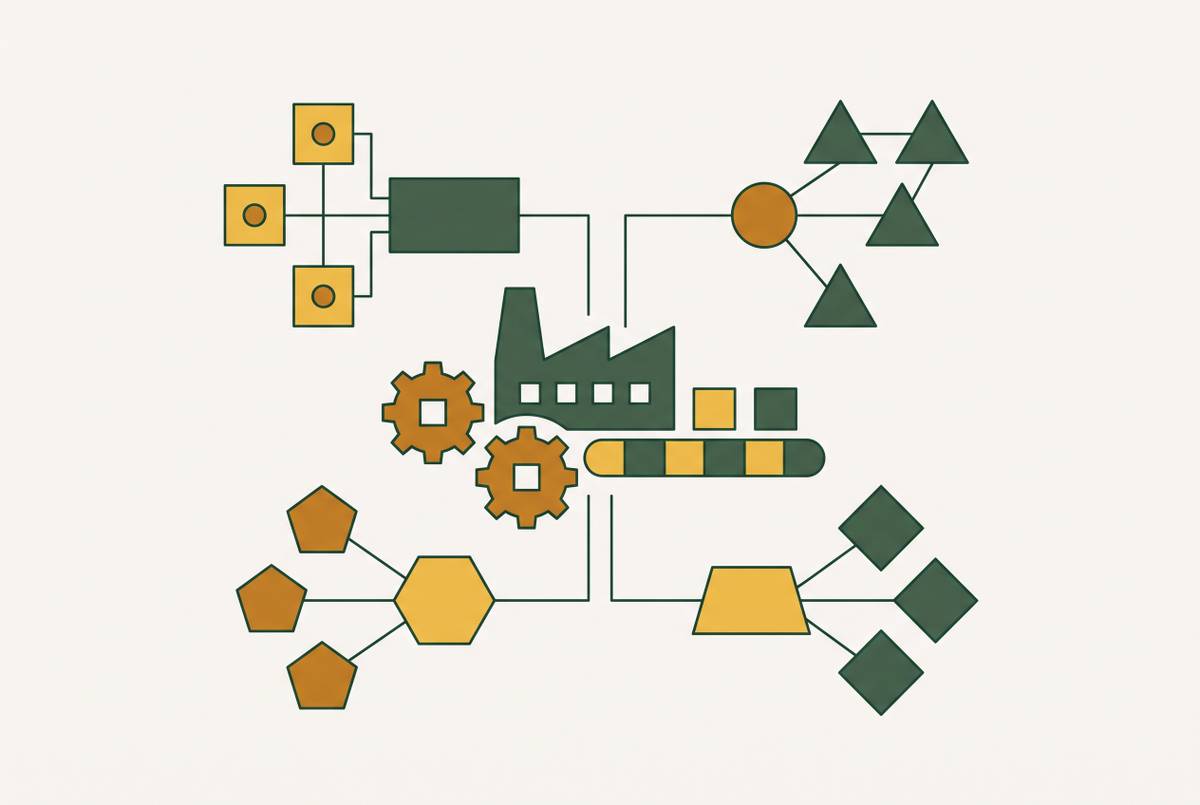
A hybrid deployment places training workloads in public cloud, continuous inference on owned edge hardware, and document retrieval on a managed sovereign platform, and it comes from a genuine analysis of where each workload sits against the five factors described above. A hybrid deployment adopted because no one wanted to commit to an answer looks identical on an architecture diagram but behaves very differently in production, because the placement decisions inside it weren't actually made, they were deferred. In industrial operations running mission-critical workflows, the binding constraint is rarely cost. It's whichever of the five factors, sovereignty, compliance, latency, throughput economics, or failure tolerance, would break the process if violated, and that constraint is different for a plant-floor control loop than it is for a construction scheduling agent or a logistics manifest system. This is why Terminal Use's approach begins with a process audit rather than an infrastructure mandate: identifying which constraint would actually break a given deployment shapes the architecture decision, rather than the architecture decision being chosen first and the constraints discovered afterward.
Hybrid deployment, done well, is the end product of five separate, factor-by-factor evaluations across every workload an organization runs, not a single infrastructure choice applied uniformly. Done poorly, it's a label applied after the fact to a set of decisions nobody actually made. The distinction between the two isn't visible in a diagram. The distinction becomes visible the first time a workload fails under a constraint nobody evaluated for it, and by then the cost of the oversight has already been paid.