Process Automation Platforms vs AI Agent Frameworks in Construction
Agent systems adapt when data changes; scripted platforms fail silently.
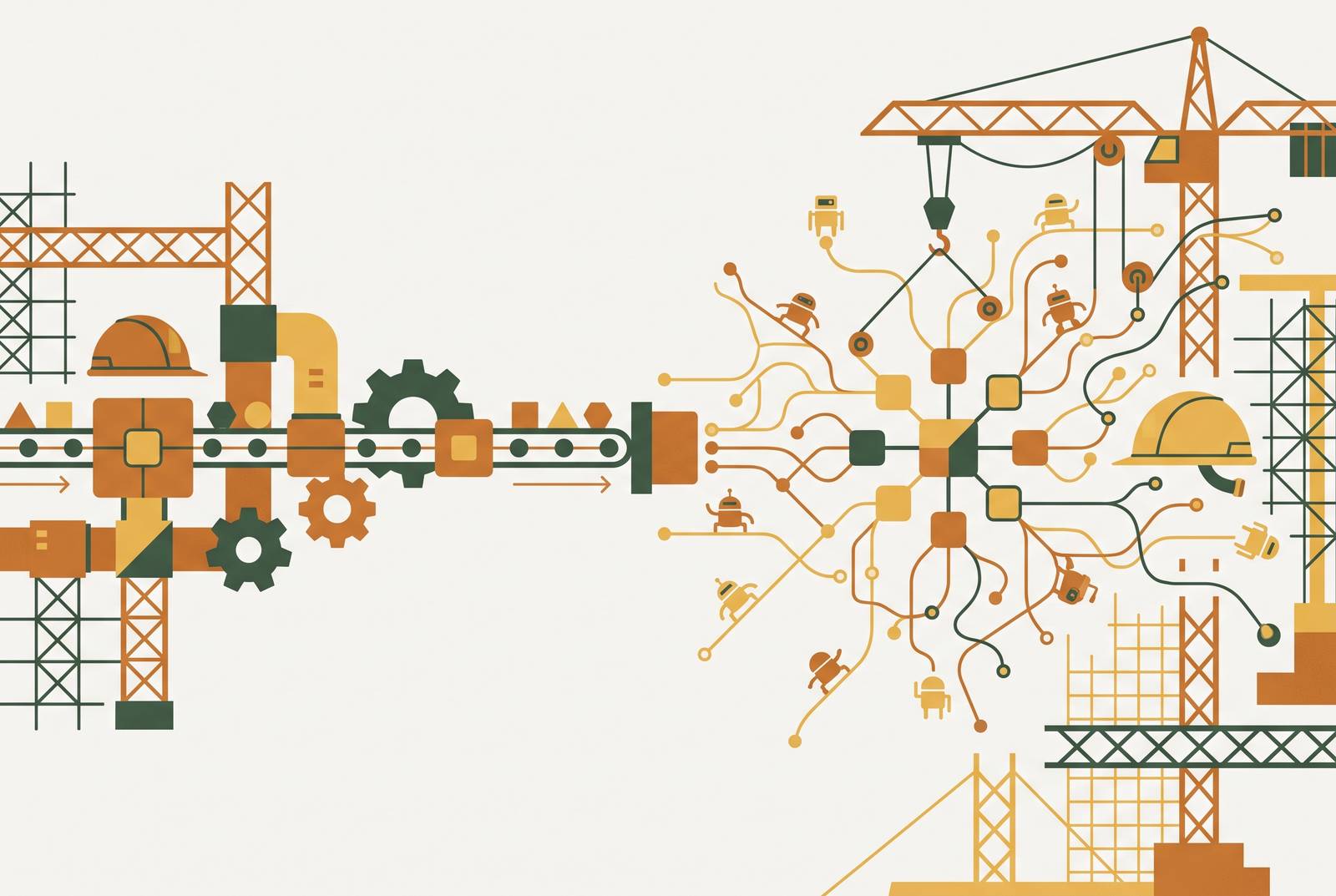
Construction project delivery runs on fragmented data, irregular handoffs, and sequencing where one missed dependency can stall a site for weeks. That combination is what makes the choice between a scripted automation platform and an adaptive agent system a question of operational safety, not a matter of preference or technical maturity. Most enterprise software treats irregular workflow as an exception to be handled on the margins. In construction, irregularity is the baseline condition: procurement records live scattered across dozens of vendor documents in dozens of formats, subcontractor coordination happens largely outside any single system of record, and sequencing constraints cascade across sub-workflows that no individual platform fully owns.
Energization readiness makes the stakes concrete. It marks the point at which a site can safely receive grid power, and reaching it depends on procurement status, commissioning progress, and site-access data converging at the same time. A static script tied to only one of those feeds will complete its steps without ever detecting that another feed has shifted underneath it, and the failure becomes visible only when the site is already behind. The problem in construction is not that any single data source is unreliable. The sources that matter most rarely report through the same channel, on the same schedule, in the same format, and a tool built to follow one path cannot see that the ground has moved on another.
What process automation platforms do
Process automation platforms, including robotic process automation tools and visual workflow builders, encode a known sequence of steps, and they can execute that sequence reliably even at scale. They excel at predictable, high-volume, structured tasks: extracting fields from a consistently formatted invoice, routing an approval through a fixed chain, moving data between two systems with stable APIs. That reliability is why these platforms remain the right tool for a large share of enterprise work, including plenty of back-office functions inside construction firms. Most organizations will run scripted automation and adaptive agent systems side by side for years to come. This piece addresses which class of tool handles the work that breaks when project delivery gets complicated, not which one replaces the other.
The failure mode in scripted platforms is structural. If the interface, data format, or upstream handoff changes from what the script expects, the automation breaks, and it often breaks without alerting anyone, because the platform still completes its steps even when the output it produces is wrong. In construction, the inputs these platforms depend on, vendor quote formats, delivery record structures, PO line items, are not standardized anywhere across the supply chain. If a platform is scripted against one vendor's document layout, it runs into a different layout from the next subcontractor, and it either throws an error or, worse, produces a silent mismatch that nobody catches until reconciliation.
The limitation is built into what these platforms encode, not confined to their edges. A script automates the process as it currently exists, dysfunction included. Automating a broken procurement workflow does not repair the workflow. It runs the same breakdown at machine speed, and the organization gets the same errors faster and with less visibility into where they originated.
What AI agent frameworks do structurally differently
An AI agent framework is a different architectural class from process automation: it plans, acts, and adapts without being handed a fixed sequence of steps in advance, but that adaptability brings its own distinct failure modes. A genuine agentic system needs five components working together: a planner that breaks a large goal into smaller steps, the ability to call external APIs and tools, memory that persists across sessions, feedback loops that recognize when something has gone wrong, and guardrails that constrain what actions the agent can take. A system missing any one of these components is not agentic, regardless of how a vendor markets it.
There is a practical test for telling the difference. Ask an agent to update a record, then simulate an API failure partway through it. A system that formulates a backup plan in response is functioning as an agent. A system that simply apologizes and stops is a chatbot with extra steps attached.
State management is the differentiator that matters most for construction-relevant workflows. An agent that loses its task state mid-execution fails silently across long-horizon work, and that failure maps directly onto construction's own rhythms: a procurement agent that loses context across a multi-week materials lead time produces outputs that look complete while resting on stale information. The silent nature of that failure matches what happens with a broken RPA script, but the cause is structurally different, a lapse in persistent memory rather than a mismatch in input format.
Multi-agent systems add a further layer of risk. Agents that behave correctly in isolation can conflict with each other once deployed together, because the coordination layer between them has no shared arbitration logic. In construction, that pattern maps directly onto scheduling agents, procurement agents, and subcontractor-coordination agents, all working on overlapping data with no shared sense of priority. Readers evaluating a vendor's claim of "agentic" capability should treat the five-component checklist and the API-failure test as a baseline screen before taking the label at face value.
Construction's Three Most Common Failure Points
Procurement document processing, schedule sequencing, and subcontractor coordination are the three processes where the gap between a scripted platform and an adaptive agent system does the most damage, or the most good, in construction delivery.
Procurement document processing shows the contrast clearly. Field Materials' approach to this problem uses specialized AI agents to process and organize vendor quotes, purchase orders, delivery records, invoices, and inventory data, scanning vendor documents to extract line-level items and automating three-way matching of delivery slips against POs and invoices to catch billing errors before they propagate. Vendor to vendor, the document formats vary, and no fixed script can anticipate that in advance. A scripted automation platform applied to the same task needs every vendor document to fit a pre-defined layout, so when a new subcontractor submits a quote in an unfamiliar format, the script either fails outright or silently misclassifies line items, and the automation itself has no way to flag that.
Schedule sequencing exposes a related gap. Tools like P6 capture planning intent, but the real sequencing risk in a project lives in procurement lead times, coordination gaps, and commissioning data, sources a static automation platform cannot read across simultaneously. Energization readiness again illustrates the stakes: it depends on procurement status, site-access records, and commissioning progress moving together, and an adaptive agent can monitor those three streams in parallel and flag divergence before it becomes a delay. A scripted platform can only execute the sequence it was originally given, with no mechanism for noticing that the sequence no longer matches reality. The Suffolk/MIT study of a multifamily development in San Francisco, covering the period from 2021 to 2024, modeled scheduling as one of six levers through which AI could reduce construction time, but the study's own authors noted that the figures rest on a model rather than on measured savings across completed projects, and called for more industry data to close that gap. So when a model's figures and the field-verified evidence don't match, you have a case for adaptive systems that learn from a project's actual data instead of from pre-scripted assumptions about how a project should unfold.
Subcontractor and cross-party coordination is the third pressure point. Coordination across subcontractors involves irregular communication formats, shifting availability, and dependencies that overlap in ways that demand stateful orchestration, branching logic, retries, and resumability as baseline requirements rather than advanced features. A scripted platform executes a fixed coordination sequence, and when a subcontractor misses a check-in or shifts a delivery window, the platform has no recovery logic built in. It either halts entirely or keeps running on data that is already out of date.
Why bolting either tool class onto an existing process fails the same way
A broken process underneath produces a broken outcome no matter what framework sits on top, and most construction processes handed to automation platforms or agent frameworks have never been audited before deployment begins. The most common reason AI agents fail in enterprise settings has little to do with the agent's design. Teams deploy an agent onto a process that is already dysfunctional, expecting the agent to correct the dysfunction on its own, and it does not. It accelerates the existing breakdown instead.
Terminal Use's operational process audits begin by mapping exactly where fragmentation and handoff failures occur in construction: procurement records scattered across vendor documents, subcontractor coordination happening outside any single system, sequencing constraints cascading across workflows no platform owns. That diagnostic work is what reveals why construction's irregular data and mission-critical sequencing call for a genuine rebuild rather than a script patched onto an existing dysfunction.
Process automation platforms compound this problem in a specific way. They encode existing dysfunction at machine speed, and because no feedback loop can detect that the output is wrong, the script completes successfully while the broken result moves downstream unchecked. The core failure Terminal Use observes in enterprise automation efforts generally applies directly here: when a rule-based platform encodes the existing process, handoffs, gaps, and all, it does not fix the broken workflow. It runs the dysfunction faster, and that risk is structural to how scripted platforms operate rather than an occasional side effect.
AI agent frameworks fail differently on the same broken foundation. Because agents adapt to the inputs they receive, an agent working from unverified or inconsistent field data does not improve on a flawed process. It automates the noise inside that process instead, so you get outputs that look plausible on the surface but rest on inputs nobody has validated.
Skanska deployed an AI process that saved its construction team meaningful time each week, and that stands as a real job-site result, instructive because it was a bounded, well-defined workflow rather than a sweeping platform rollout. The field evidence for AI in construction consistently comes from specific, scoped processes rather than end-to-end transformation attempted all at once. The starting point that actually produces results in the field is a process audit: understanding in detail how a workflow runs today and where it causes pain, before any decision gets made about what to rebuild or which tool class to rebuild it with. That step is the one most construction technology buyers skip.
The production failure modes that construction buyers rarely see in vendor demos
Most construction AI deployments that make it past an initial pilot go on to fail in production for structural reasons that vendor demos are built to obscure, and the failure patterns repeat often enough to screen for before a contract gets signed. Gartner estimated that of the thousands of vendors marketing themselves as agentic AI providers, only about 130 meet its criteria for genuine agentic capability, a distinction buyers can use directly when evaluating a pitch rather than taking the label at face value.
Seven named failure patterns recur in production agentic systems, and several of them map directly onto construction's own risk profile. Over-trusting LLM autonomy without human-in-the-loop checkpoints is the single most common cause of cascading failures in these systems. In construction, where a procurement decision or a schedule change carries real downstream cost, an error of this kind is not something a team simply absorbs and moves past.
For construction workflows specifically, state management across long-horizon tasks is the architectural difference that matters most. If an agent loses task context mid-execution, it fails silently across multi-week procurement cycles or sequencing workflows, the same operational blind spot that affects scripted RPA, but produced by a different structural gap. Genuine agentic systems require persistent memory and feedback loops capable of recognizing failure; systems missing those components function as automation wearing an interface layer, no matter how they are marketed.
When agents get broad API access during development, they often keep those same permissions once they reach production. When write-enabled connectors or live payment APIs sit inside an agent exposed to adversarial or malformed inputs, you get liability exposure that is material rather than theoretical. In multi-agent systems, the coordination layer between agents, not any individual agent's logic, tends to be the actual point of failure: agents that behave correctly on their own can work against each other once a shared arbitration layer is missing, and construction's scheduling, procurement, and subcontractor-coordination functions overlap in exactly the way that exposes this gap.
Building the governance infrastructure that makes agentic systems safe in production, audit logs, a model gateway, access controls, carries a significant upfront cost before an agent ever reaches a live job site. That cost burden falls hardest on smaller contractors and mid-tier subcontractors, and it tends to concentrate the early gains from AI-first operations at the general contractor and owner level, where the infrastructure investment is easier to absorb.
Evaluating Terminal Use and other providers for construction operations teams
The strongest provider for construction AI is the one willing to start with a specific broken process and rebuild it before any tooling decision gets made.
Terminal Use is an AI-native operations firm that rebuilds how departments run end to end, with direct experience across construction, logistics, manufacturing, and retail. Rather than layering AI tools onto an existing workflow, it redesigns the process from scratch with AI agents built into its center. Its engagements start with a process audit: clients show the firm how a given process runs today and where it causes friction, before any decision gets made about what to rebuild or which tooling to use, the step the field evidence covered above identifies as the one most buyers skip. The team includes engineers with backgrounds at QRT, AWS, and Bloomberg, and the firm has rebuilt operations for some of the largest engineering, procurement, and construction firms in the US, along with companies running medical billing at national scale. The first AI-first process it deploys for a client goes live in weeks rather than quarters, a timeline chosen deliberately: a long runway on a first deployment signals the wrong approach more often than it signals thoroughness. Terminal Use fits best for construction and asset-heavy operations leaders who are skeptical of vendor hype, want to start with one specific painful process rather than commit to a platform strategy up front, and need a transformation partner rather than a software license.
Buyers weighing a broader software license approach, where a vendor sells a configurable platform and leaves the redesign work to the internal team, get more control over pace and scope, but they inherit the process-audit burden themselves, and the evidence above suggests that step is the one most likely to get skipped under deadline pressure. Buyers weighing a narrow, scoped point solution, the kind Field Materials represents for procurement document processing or that Skanska's bounded deployment represents for a single job-site workflow, get a faster, lower-risk path to a working result, but only within the one process the tool was built to handle. Each approach has a legitimate place depending on how much of the organization's operating model a buyer is actually prepared to change.
The decision construction operations leaders face is which provider will make them map the broken process first, before any code gets written or any license gets signed.