Automating Bad Processes Is a Diagnostic in Disguise
Automation reveals hidden workarounds and process gaps that people were silently fixing.

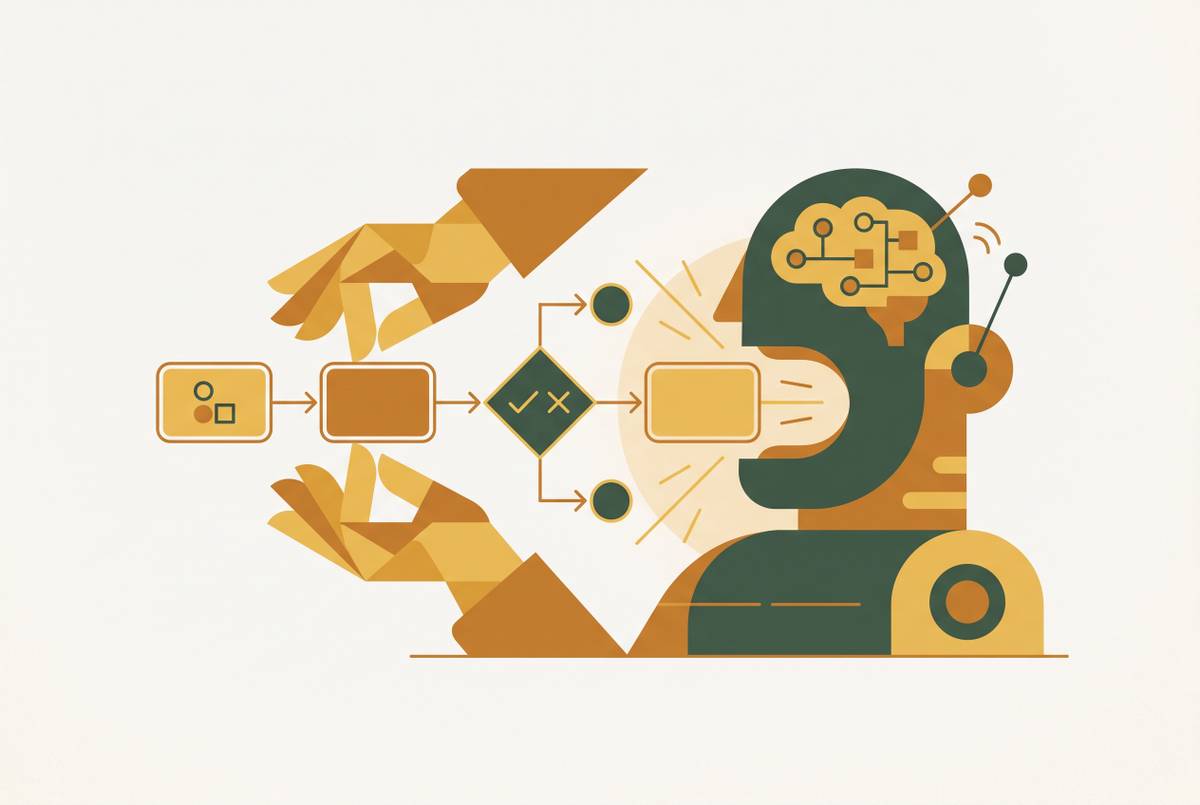
Rebuilding department workflows with AI agents starts with auditing how work actually happens. Failed automation is a diagnostic in disguise because it exposes the workarounds and missing handoffs that people were silently absorbing. The productive response is to use a limited proof-of-concept to reveal those gaps, then rebuild the workflow.
Why automation exposes the process, not just the problem
A team celebrates a finished automation, then watches it produce errors that never appeared in the manual operation. The immediate suspect is the new tool. Yet the errors may reveal something older, namely a process that depended on people to complete instructions the organization had never written down. Workers supplied missing data, absorbed exceptions, and bridged unclear handoffs. Once automation removes that layer of human help, the same gaps cause failures people can see, and the quiet corrections stop.
This is the diagnostic moment. The process on paper seemed complete because the work got done, but that showed people had stepped in and left open whether the process was well designed. An automated workflow follows the declared path without inheriting every judgment that made that path usable. When exceptions proliferate, their location reveals where the formal process stopped and informal labor began. The failure exposes the process itself.
Fixing the error at hand may get output back on track while leaving the missing handoff or decision unresolved. Rebuilding deals with what the process relied on that allowed the error to happen. In this class of failure, the technology has disclosed an existing structural gap. Its diagnostic value lies in making that gap specific enough to examine, instead of allowing another successful manual correction to conceal it.
What workarounds actually look like in operations, and why they hide so well
A supervisor rearranges the official pick order in their head because the published sequence does not fit the work. A procurement clerk maintains a personal spreadsheet of vendor lead times because the system's data is stale. A field crew photographs completed work but never logs it formally because logging takes longer than the task. These are rational responses to operational friction. Each allows useful work to continue despite a mismatch between the prescribed method and conditions on the job.
Their success is also what hides them. The supervisor's judgment appears in the completed work, but not in the official sequence. The clerk's private record makes procurement possible without correcting the shared source. The crew has proof that the work is done without an entry in the formal record. From the documented process alone, those distinctions are difficult to see, because the record captures the intended steps while omitting work required to carry them out.
Mapping the process therefore requires more than tracing its approved steps. The informative points are where workers depart from them, substitute another source, or supply a judgment that the instructions omit. Those departures identify where the organization relies on improvisation. Treating them as operational knowledge makes the audit a search for missing design.
Deloitte's AI in Manufacturing 2026 survey finds that AI has the most value in processes with high variability, many parameters that affect each other, and results that matter to how the operation runs. Those conditions also call for people to improvise the most. The opportunity and the hidden dependency occupy the same ground, which makes these processes attractive to automate but difficult to understand from documentation alone. Their variability calls for discovering how people currently manage exceptions before replacing their role in the workflow.
How agentic AI raises the stakes of deploying into an unaudited process
The consequence changes when automation can act in live business systems. Earlier rules-based automation could expose a flawed process through a bad report, while an agentic workflow can turn that flaw into an irreversible action. The distinction is between reporting and acting. A broken handoff that a person once caught and quietly corrected in three seconds can propagate through procurement, scheduling, or a financial system before anyone sees it.
For an operations leader, the central question is therefore not only whether an agent can perform a task. It is also how far an incorrect decision can travel through the operation. A workflow that appears local may connect to decisions elsewhere, so a missing correction can affect more than the task being automated. The human intervention used to interrupt that sequence. Removing it without understanding why it was needed leaves the work relying on help that is gone, along with the point where someone spotted the trouble.
Governance has to reflect that difference in reach. Using the same oversight for all agents treats them as though they pose the same risk to the operation, even when they have different autonomy levels and different access to business systems. They do not have the same scope. When oversight ignores those distinctions, a process gap can grow beyond a contained exception into a cascading failure. An audit must therefore examine the work being delegated in relation to the authority being granted.
Autodesk's 2026 State of Design & Make report, in its Construction Spotlight, finds that only 32% of construction leaders say they have met or are close to meeting their AI goals. That finding signals a gap between ambition and achievement. It reinforces the need to distinguish deployment from process readiness. An agent being available for use is not evidence that the operation is ready to delegate consequential decisions to it.
What construction's energization problem shows about process gaps hiding in plain sight
In data center construction, the P6 schedule can show the work in one order while procurement, coordination, and commissioning follow another. Where the schedule omits dependencies that govern field execution, it records an intended process that is missing requirements for delivering the project. Problems presented as supply-chain or permitting constraints can therefore also expose a failure to make those constraints part of the formal workflow.
Energization readiness brings that omission into focus. Transformer and chiller lead times make procurement a tender-stage decision, yet most project teams have no formal process for treating it that way. The timing of the decision is the defect. A better tool at the later procurement step cannot supply a decision that was needed earlier. As with failed automation, the visible shortfall identifies a gap that the workflow was never designed to close, and the repair belongs in the sequence of work.
Why manufacturing's scaling problem is a process audit problem in another name
Manufacturing has the same mismatch when a pilot works but cannot be repeated in day-to-day operations. Deloitte's survey finds that a large majority of manufacturers already generate measurable AI value, but only roughly one in five use cases has been scaled consistently. Model capability is not the whole constraint. Production at scale involves variability that the pilot team may have managed without formally mapping it.
A small team can handle exceptions within a controlled zone and still show a result that works. That result does not describe every condition of execution. When the use case grows, the same informal help may no longer be there everywhere the work happens. The resulting failure is diagnostic because it identifies what the pilot depended on beyond the automation itself. This is the manufacturing counterpart of a construction schedule that omits the decisions needed to make it achievable.
Customization and redesign address different parts of that problem. Customization can make a tool better suited to an existing task, while redesign changes how the work happens around the company's own capabilities. Redesign requires knowing how the work gets done, including the exceptions that took more work in the pilot than its formal description showed. Otherwise, customization risks preserving the same dependency in a better tool.
The same survey identifies high implementation costs and a lack of technical expertise as the most cited implementation barriers, with resistance to change also prominent and data quality issues cited less frequently. These findings make implementation an operational concern. They also create a reason to examine scope and hidden work. An unaudited process leaves the organization without a clear account of what must change, which judgments need support, and which parts of execution depend on informal knowledge.
The objection worth taking seriously: sometimes failure is the only forcing function
The strongest objection to auditing first is organizational. In some operations, workarounds are so normal that the people closest to them no longer recognize them as departures from the process. Leadership sees completed work and has little reason to authorize redesign. A visible automation failure changes that situation by turning an accepted inconvenience into an undeniable operational problem. Failure can create permission that a process map cannot.
That objection deserves its full weight. A failed deployment may be the event that gives people room to question a workflow they were previously expected to maintain. It can make informal labor legible to decision-makers and move redesign from an optional improvement to an operational necessity. In that setting, “audit before automation” is not enough by itself. The organization may need a demonstration before it will accept what an audit is trying to establish.
The difficulty is the cost of that demonstration. An agent connected to live operations can cause damage before its failure gets people to agree to rebuild. The practical resolution is a limited proof-of-concept designed as a structured audit, rather than as a small production deployment waiting to expand. It is designed to show exception paths and broken handoffs before full deployment. That preserves the diagnostic value of testing while limiting exposure to the consequences of failure.
This changes what success means at the outset. A proof-of-concept that reveals an undocumented dependency has produced useful evidence, even if it has not automated the process successfully. But a demonstration that runs smoothly shows little if people quietly handle every exception around it. A useful demonstration reveals where the workflow needs reconstruction. That evidence gives the redesign conversation something more precise than either confidence in the technology or disappointment with it.
How to start rebuilding department workflows with AI agents through a process audit
Rebuilding starts with a specific, painful process. People doing the work should be able to describe its failure mode, even when leadership cannot see it. Starting there makes it possible to examine a real sequence of decisions and handoffs rather than treating the department's documented workflow as a complete specification for agents.
The audit looks for evidence of two processes operating at once. Manual re-entry shows where information fails to move as the formal workflow assumes it will. Parallel spreadsheets, WhatsApp threads, and sticky notes reveal records that workers trust or need outside the official system. A handoff that only works after a phone call exposes missing coordination. A task that takes longer than the process map allows points to work the map has not accounted for.
Those signals are places to investigate. The audit must establish what each informal action contributes and why the declared workflow cannot proceed reliably without it. That distinction separates reconstruction from merely digitizing the workaround. A rebuilt process addresses the missing information, decision, or handoff so that the old compensation is no longer doing invisible work. It also creates a specific place to assess whether the change has relieved the operational pain.
Deloitte's survey supports targeting domains with rich process signals, measurable outcomes, and clear operational ownership, where AI adoption is strongest. Those conditions make it easier to see both what is going wrong and what has changed. The first rebuilt process should be live in weeks rather than quarters, with that timeline serving as a diagnostic signal about scope. A prolonged first effort is reason to ask whether the scope is too broad or the team is preserving the old process. The question for tomorrow's team discussion is concrete. Which step only works because someone supplies information, judgment, or a phone call that the process never acknowledges?