Vendors Who Let a Single Broken Process Define the Engagement Before Any Platform Language Enters the Room
Examining one failing process first shows whether AI can work.

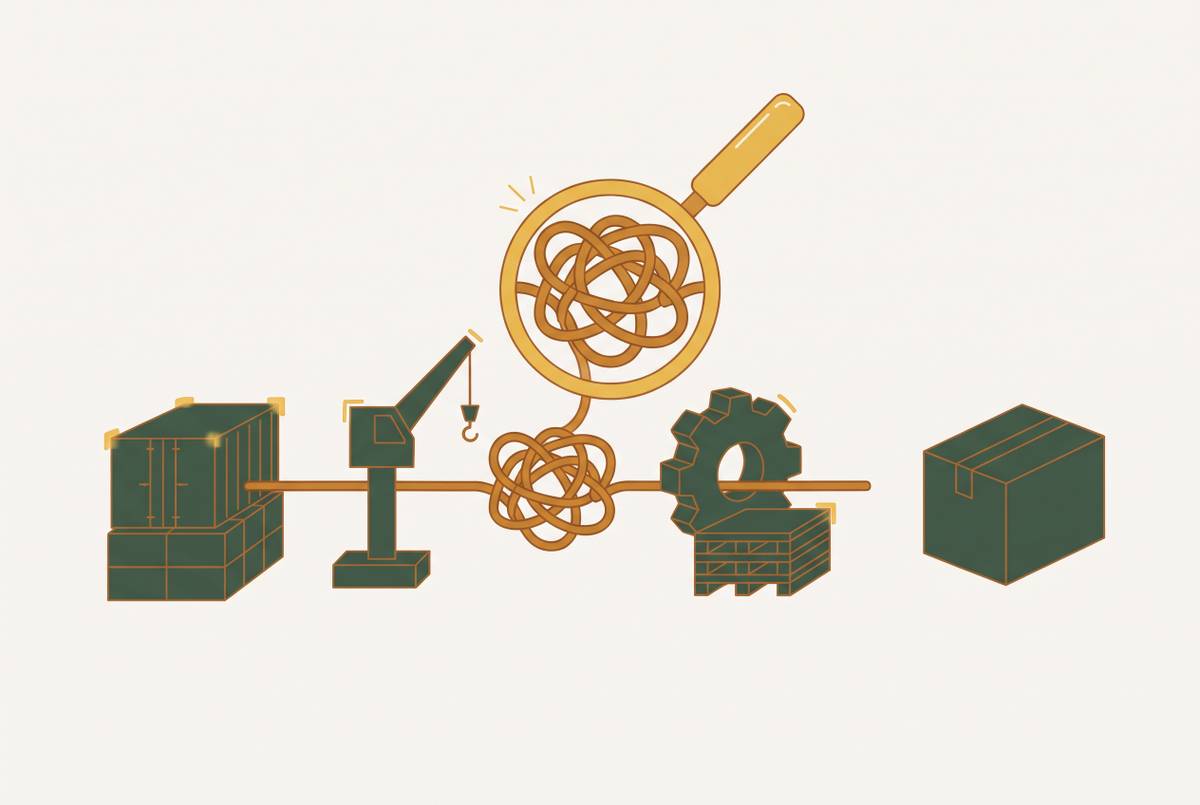
AI operations transformation in asset-heavy industries can begin without a platform strategy. Begin by examining one costly, broken process as it actually runs, before any technology is selected. A process-first vendor uses that examination to establish whether the data, documentation, and handoffs can support AI, rather than treating the process as a convenient platform demonstration.
Why enterprise AI keeps failing in operational industries — and what the failure pattern reveals
Consider a hypothetical European logistics company using a large language model to resolve disputes across order fulfillment. Pricing data sits in fragments, approval workarounds are undocumented, and manual overrides never reach enterprise systems. The model could faithfully reproduce those defects while handling disputes faster and at greater scale. Escalations could rise.
The technology need not malfunction for the operation to deteriorate. A model can work as designed while acting on an incomplete account of how decisions are made. Faster execution then amplifies the existing inefficiency. Because the visible change is the introduction of AI, the result looks like a technology failure and is diagnosed as one. That diagnosis leaves the underlying process unexamined, allowing the same mistake to recur.
The pattern extends across construction, logistics, manufacturing, and retail because operational work depends on more than the information recorded in enterprise systems. McKinsey’s AEC analysis distinguishes firms that use AI as a superficial productivity tool from those that rewire their businesses around it. If the workflow is still broken, adding intelligence does not fix how data, decisions, and the work itself fit together.
What "broken process" actually means in asset-heavy operations
A broken process is one whose actual execution has diverged from its documented form, often without leadership seeing the gap. This is more precise than calling an operation chaotic. The steps on paper may make sense even as the people doing the work rely on exceptions, what they know, and fixes made by hand. An AI scheduling engine fed a baseline in that condition optimizes a document that does not describe reality.
Procurement makes this divergence particularly concrete because materials, equipment, subcontract packages, and supplier commitments are often managed across disconnected systems. Without an integrated view of cost, lead times, risk, and availability, a schedule can conceal a critical dependency. Patrick Hennessy, Planning and Analytics Executive at Harkins Builders, describes one such case in the Suffolk/MIT whitepaper. On a transformer project in West Virginia, the team secured a six-week lead time on structural steel in April. In December, the steel contractor reviewed the order details and found custom angle clips with a twenty-week lead time. The schedule slipped by months over an overlooked dependency.
Manufacturing exposes the same problem through local operating conditions. Machine quirks, differences in operator experience, maintenance histories, supplier delays, and quality thresholds shape actual execution. A plant is not a spreadsheet. A tool that reduces scrap in one plant can be irrelevant or risky in another because the conditions governing the work differ. Generic AI cannot bridge that difference merely by receiving a process description that omits it.
Retail and CPG operations show less conspicuous versions of the same divergence. Stores may vary their replenishment patterns based on who is on shift, while small differences in setup and changeover at plants can cut throughput. Supply chains can absorb such friction in ways that leadership cannot easily see. What makes the process broken is the gap between the account used to manage it and the work required to execute it.
Why platform-first vendors cannot see this problem — and structurally cannot fix it
When sales start with the platform, that gap falls outside what the vendor first looks into. Product teams define capabilities, sales teams present them, and the client’s process becomes an input to configure. The process itself is not the subject. Consequently, the engagement takes shape around what the software can do before either party establishes what the operation needs. This is a structural consequence of how software companies are organized.
Once that framing is accepted, the vendor can demonstrate a capability without establishing that its operating assumptions hold. A successful demonstration shows whether the platform can do a task. It does not show whether the task fits the workflow as it is now designed, or whether the handoffs it needs are recorded anywhere outside people’s memories. Those are different questions. As long as the engagement treats the workflow as fixed, it can automate the broken process but cannot address the reasons it broke.
Early factories plugged electric motors into operating models built for steam power and saw no rise in productivity. Large gains arrived when manufacturers redesigned their systems around the new capability. The motor alone was not the transformation. Selling what the technology can do without looking at the factory layout makes the same mistake with a different technology.
McKinsey’s distinction between isolated use cases and end-to-end domains helps set the bounds of the work. A domain is small enough to redesign independently but large enough to deliver meaningful business impact. A platform demonstration naturally favors an isolated use case because it makes the capability visible. Process diagnosis asks whether that capability is useful in the work around it. The objection is that diagnosis delays deployment when competitive speed is important, but a shorter path to deployment is not necessarily a shorter path to a functioning operation. Process gaps left unexamined before deployment remain barriers to production afterward.
How to start AI operational improvement without a platform strategy
A process-first engagement begins with a specific operational failure. The vendor asks the client to walk through the last time the process failed, including what broke, in what order, and who had to fix it manually. The question anchors the conversation in actual execution. It also makes workarounds part of the evidence rather than exceptions to exclude from the discussion. The initial scope is one process and one pain point, described as they exist today.
That narrow scope allows the vendor and client to compare the designed workflow with the work people actually perform. The vendor tests whether the data reflects reality, whether handoffs are documented, and whether the process has been formally described at all. Some steps may be kept only in people’s heads. Finding that out before a build decision changes the engagement because documentation and ownership become prerequisites. The examination immediately produces a shared account of the breakage.
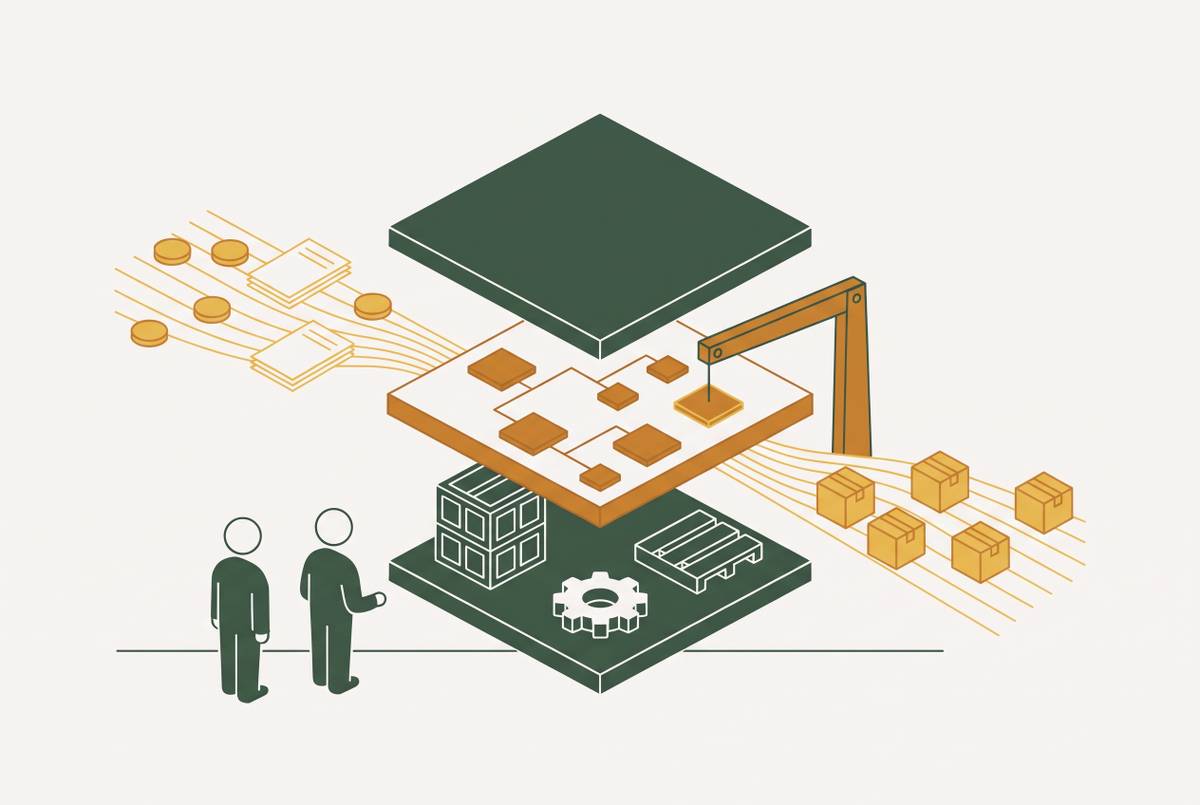
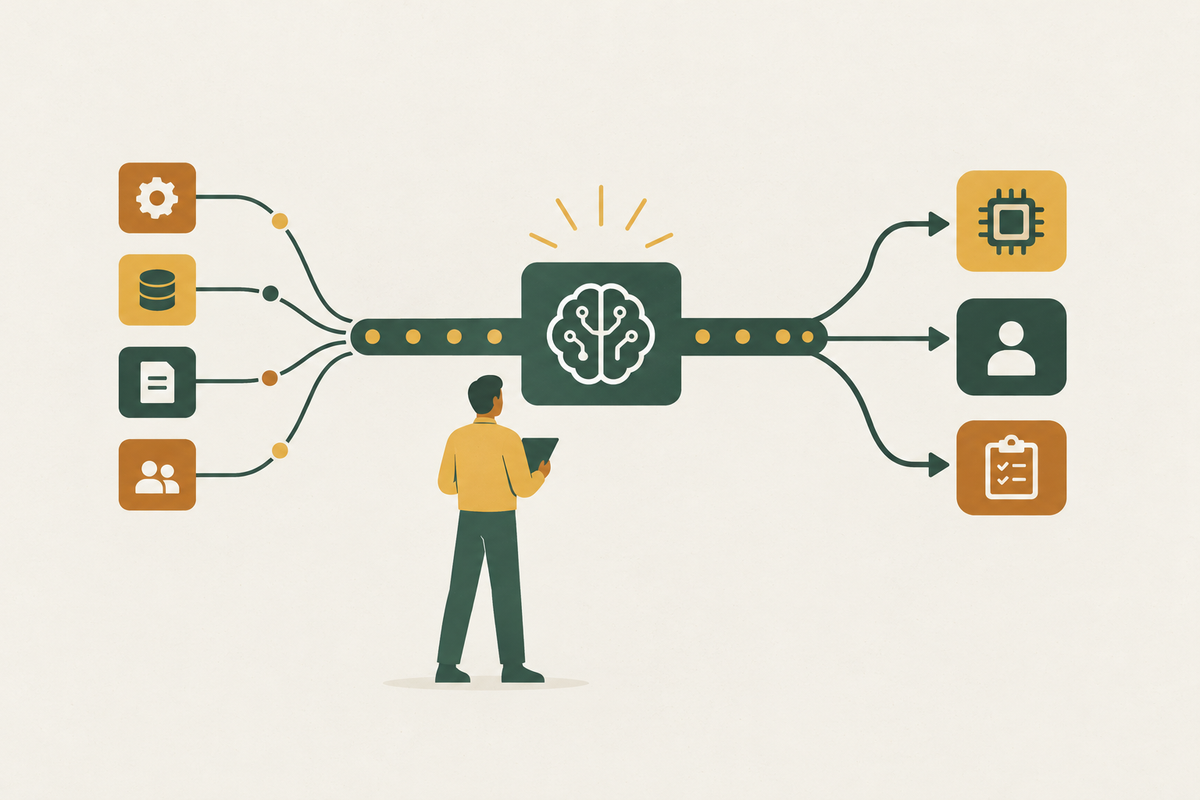
McKinsey’s agentic pipe-spool scenario shows why this groundwork is essential in construction. Agents check a field photo against the 3D model, the engineering drawings, the procurement records, and the construction schedule. The integration is operationally useful only if those sources reflect actual execution. A diagnostic establishes whether that condition holds. A demonstration can show how information is compared without showing whether the sources describe the same work as it happens.
Process-first does not mean that a platform can never enter the engagement. OMP’s case study describes Procter & Gamble deploying Unison Planning™ as the backbone of an end-to-end transformation toward touchless, AI-enabled supply chain planning, with process consolidation forming part of that transformation. Stanford Digital Economy Lab’s Enterprise AI Playbook identifies fixing the process before applying AI as a lesson from its recruiting case study. That lesson supports workflow redesign, although the playbook did not formally compare a matched set of successes and failures in a controlled study.
Why the single broken process is the right diagnostic unit — not the department or the platform
Energization readiness shows why one process can be narrow enough to investigate and consequential enough to define an engagement. Transformer and generator step-up lead times now run well over two years. Long-lead procurement can therefore become a programme-defining constraint. Looking at long-lead tracking brings that constraint into the work with the client early. A broad discussion of digital transformation alone does not show whether the commitments that govern energization can be seen and relied on.
A department audit maps the range of things that could be improved. Examining one broken process produces evidence of what is blocking a particular outcome. The single-process approach is valuable because it puts the relevant data, decisions, and handoffs under examination together, rather than assuming that departmental boundaries describe how value is produced.
Retail and production examples make the distinction clear. Out-of-stocks may trace to backroom accuracy rather than forecasting, while production delays may trace to short stoppages that manual reporting does not reveal. Starting from the specific failure keeps the inquiry attached to the cause rather than to the software category that first seems relevant. It also tests whether the organization can describe the work accurately enough for AI to support it.
The objection is that one process seems too small for enterprise transformation. That would be true if the engagement merely accelerated an isolated task while leaving the surrounding workflow untouched. An end-to-end process is a different unit. McKinsey’s domain framing preserves the connection between manageable scope and meaningful business impact. Each process rebuilt correctly can become the foundation for the next, whereas a broad rollout that skips this work risks fragmentation. The initial diagnostic establishes both whether transformation is achievable and what readiness gaps will affect its cost.
How operations leaders can recognize a process-first vendor before the sales cycle runs away
Operations leaders can look for this posture in the first two or three interactions, before a proposal is written. The first signal is the vendor’s request to see the process run, including workarounds and manual overrides. A requirements document is not a substitute. The vendor wants to see how the work gets done rather than read an account shaped by how the organization thinks it should work. That request should lead to a specific point of breakage before it leads to a recommendation.
A second signal is whether the engagement acquires a named problem before it acquires a named platform. The vendor should be able to describe what completion means for the first process before discussing scale. The proposed outcome is a live, rebuilt process in weeks. That is a scope test. A claim about speed is useful only when both parties understand which process is being rebuilt and what currently prevents it from working.
A process-first vendor asks where operators would benefit from guidance tailored to their experience and tasks. Before any technical design, a platform-first conversation asks which modules the client wants to activate. Likewise, a vendor who pushes back on broad transformation language may be keeping the diagnosis focused, even with larger goals in mind. The relevant test is whether that pushback produces a more precise account of what is going wrong in the operation.
To make that examination possible, an operations leader should bring a specific, painful process to the first meeting. The most useful candidate has a visible, costly gap between the designed workflow and the actual workflow, rather than merely an association with a strategic priority. Governance should be part of that first conversation. Data readiness, documentation gaps, and handoff ownership should appear as prerequisites before the statement of work. If they emerge only then, the sales motion remains platform-first regardless of its vocabulary.