The Process Triage Logic That Tells a Heavy Operation Where AI Should Touch First
A process triage method shows heavy operations which broken workflow AI can actually fix.
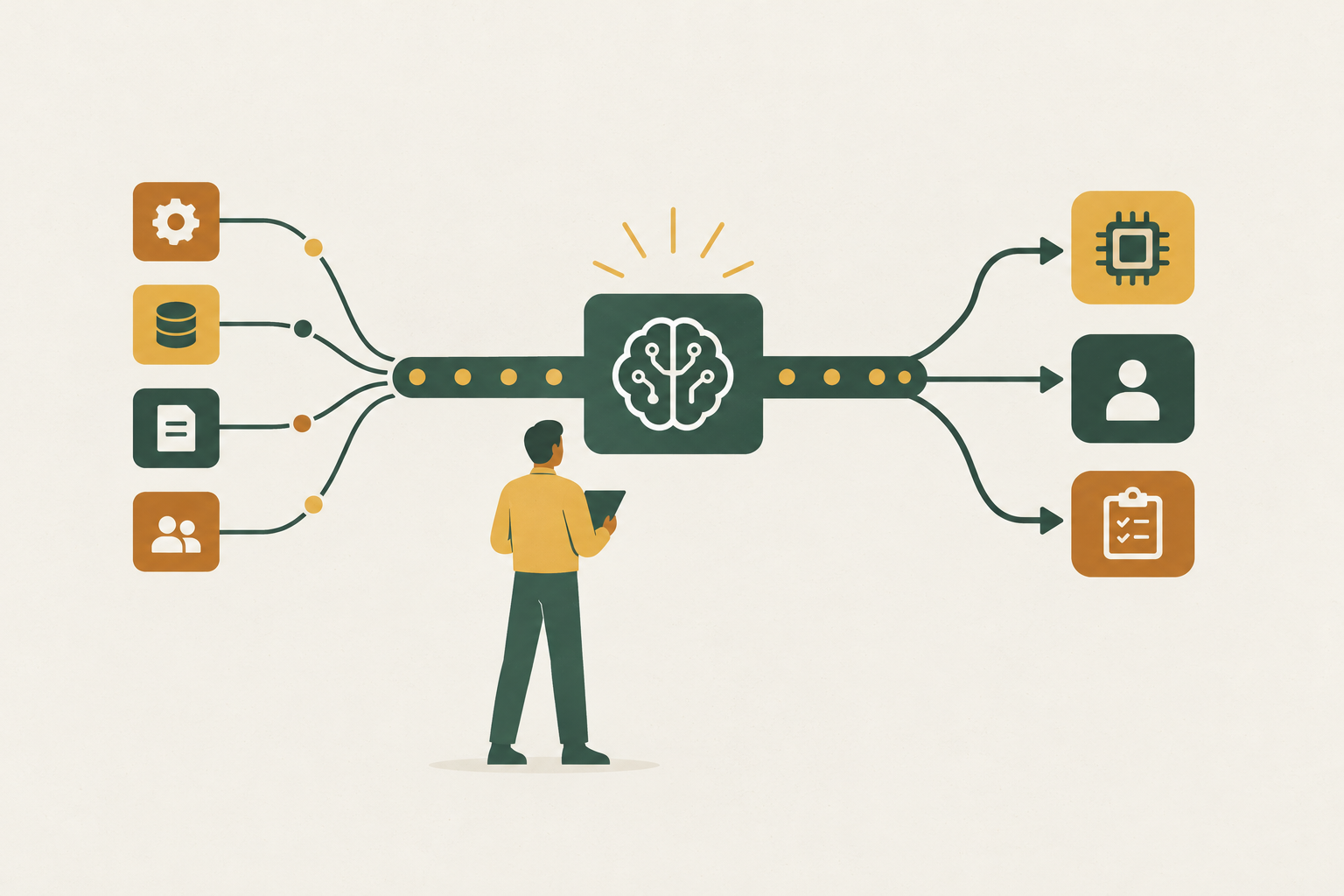
AI operations transformation in asset-heavy industries can begin with one broken process, without a whole-platform purchase or an enterprise software roadmap. The entry point should be a process that has high volume, takes a lot of effort, and has repeatable steps, measurable outcomes, and usable data. Process triage identifies where declared performance diverges from field reality and assesses AI’s ability to address that specific failure and its risk of inheriting it.
Why process selection is the highest-stakes decision in an AI deployment
Vendor demonstrations tempt operations teams to judge AI by what it can do. Capability surveys take that approach further by listing what can be deployed, while platform roadmaps tend to favor what is easy to integrate. Neither diagnoses the process behind the proposed use case. Feasibility is not evidence of operational value. A system can execute its assigned task successfully while reinforcing the logic that caused the failure.
That distinction makes process selection more consequential than the capability of the system chosen. AI amplifies the underlying process and, when that process is broken, can accelerate and embed its defects. Reversing that choice involves more than replacing software because integration costs, change fatigue, and lost credibility with operations teams compound. The first decision therefore establishes both the opportunity for improvement and the cost of being wrong.
The Suffolk/MIT AI white paper identifies six construction value levers, including design automation, offsite manufacturing, permitting, scheduling, skilled labor and subcontracting, and supply chain and procurement. Those categories describe where value might exist, but they do not identify which process is broken in a particular operation. That requires a different question. Where does the operation already break, and would AI fix that break or inherit it? Process triage shifts the decision from technology evaluation to diagnosis.
What makes a process a triage candidate — the three conditions that identify a genuine entry point
A viable entry point combines three conditions. It has high volume and high manual effort, follows describable and repeatable steps, and produces measurable outcomes. All three conditions must be present together. Volume establishes whether improvement can extend across enough routine work, while repeatability gives an agent a process model to execute against.
Each condition also exposes a reason to defer deployment. A low-volume, high-stakes exception process fails the volume filter, even if its decisions are expensive. A process that depends on who is asked lacks a stable description. A lack of measurable outcomes for assessing the agent’s performance joins these process defects, which often point to unclear ownership, inconsistent inputs, or missing or corrupt data.
The same filter applies to logistics carrier selection, construction submittal review, manufacturing order processing, and retail demand signals, which qualify only when the way the work is done meets its conditions. Jabil’s intelligent shop floor assistant illustrates the dependency. Its training used standard operating procedures, troubleshooting guides, and technical documents that already existed, were consistent, and covered the failures operators encountered.
Why the gap between declared performance and field reality is the most reliable triage signal
Of the processes that pass the filter, the one with the widest gap between declared performance and operational reality is the highest-pain node. Declared performance is what a schedule, report, or system of record says is happening. Field reality comes from evidence such as procurement data, coordination logs, and commissioning records. The two do not necessarily describe the same operation. Their divergence is where delay, cost overrun, and coordination failure accumulate before becoming visible as a crisis.
Construction schedules make this failure especially clear. When a baseline already fails basic quality benchmarks, AI can optimize around its defects. The resulting outputs look confident because they reflect the supplied plan. The expensive edge case, which defines much of construction’s cost and schedule risk, can remain wrong even when routine outputs appear credible.
Procurement and energization readiness expose the same disconnect. Electrical procurement is on the critical path of most large capital projects, but declared delivery timelines rarely hold up against actual vendor lead times and site sequencing constraints. Agents that flag vendor delays or material shortages before they reach the critical path work on this gap. They address evidence that contradicts the plan. Applying AI only to the declared timeline instead would preserve the assumption that needs to be challenged.
Governance provides a parallel test of the same reasoning. Auditors require underlying evidence to verify a declaration of conformity. In both settings, a declaration cannot establish its own accuracy. The diagnostic task is therefore to locate the records that expose the difference. That makes the gap addressable, provided those records are usable and the process generating them is stable.
How to find one broken operations process to fix with AI without buying a whole platform
A process audit follows the work to find where handoffs stall, people enter the same information again, and coordination keeps failing. These are places where manual effort and decision volume cluster. Another signal is an exception that always reaches the most senior person available because no one else can navigate the ambiguity. That signals pain, but not necessarily readiness. The audit must distinguish repeatable work burdened by friction from work whose rules remain unresolved.
A process is disqualified when its records are inconsistent, missing, or produced by an upstream process that has not been stabilized. AI does not clean corruption merely by consuming it. A team that follows only the largest workload can therefore choose the most painful process and still choose the wrong entry point.
This distinction separates apparently similar opportunities. Invoice processing and approval routing can qualify when inputs arrive in consistent formats, as can submittal review with document standards and carrier selection with complete, clean historical performance data. Schedule optimization fails when baseline schedules fall short of quality benchmarks. Demand forecasting also fails when upstream inventory records are fragmented, while RFI generation is unready when project documentation differs across systems.
Agentic systems spanning design, schedule, procurement, field, and commercial work require unified data models and APIs that allow information to move in real time. Most heavy operations cannot meet that condition on day one. A bounded process can be assessed without assuming that the entire operation is ready for such coordination. Triage sequences processes that can support deployment now, processes needing specific data repairs, and processes blocked by unresolved upstream problems.
What sector-specific entry points reveal about where the triage logic lands in practice
These processes have many documents, clear steps, and outputs that a human can review before anyone acts. Where document standards exist, the data preconditions are more often met than in schedule optimization. This explains why the broad value levers identified in the white paper do not translate directly into an order of deployment.
ITS Logistics built applications for carrier costing, carrier selection, and trailer positioning, all processes that have high volume, plenty of data records, and measurable outcomes. ITS Logistics CIO Peter Weis reports that its carrier pricing model processed data from hundreds of thousands of annual shipments and delivered a return on investment covering the entire cost of the company’s AI initiatives. The preparation was substantial. The company spent two years building its AI platform before deploying, work that served the data-readiness requirement. Its result shows that readiness must be included in the comparison.
Manufacturing entry points follow the same pattern. Suzano, Danfoss, and Elanco entered through materials query, order processing, and document management processes characterized by volume, defined structure, and measurable outcomes. Jabil’s procedure-based shop floor queries belong to that information layer as well. Across these sectors, the triage favors information and coordination work before physical or decision work with a heavier exception burden, because the former more often supports a bounded, reviewable first deployment.
How autonomy scope and shadow-mode gating keep the first deployment from becoming a new failure point
A suitable process can still become a poor deployment if the agent receives more autonomy than its data and process maturity support. Full autonomy works for a small set of tasks that are low-risk, high-volume, and well-specified. All other tasks need assisted autonomy with clear limits. Under that arrangement, the agent executes reversible steps and stops at specified checkpoints for human approval.
Shadow mode tests that boundary before the agent acts. The agent processes inputs and generates outputs, while a human continues to perform the actual action. Comparing agent outputs with human decisions creates the validation dataset. Accuracy gating before supervised autonomous operation establishes whether the proposed entry point holds up under production conditions, rather than merely whether a demonstration was convincing.
Frequent divergence is evidence against the initial assessment. It can indicate that the process was selected incorrectly or that its data conditions are worse than the audit suggested. Either finding is useful before authority expands. Shadow mode contributes to triage by testing whether the process description and the evidence supporting deployment correspond to how the work actually runs.
Scope discipline also defines the workforce relationship. Workers supervise agents rather than simply receive automation, retaining judgment where exceptions exceed the agent’s boundary. Deloitte’s manufacturing research notes that humans still do most hours of manufacturing work even as AI expands. Jabil’s assistant illustrates this division of responsibility. Operators can perform first triage themselves before escalating, gaining access to documented guidance without surrendering judgment at the exception layer.
Why the triage must be repeated, not completed — how early deployments change the operation’s failure map
An early deployment changes the evidence available for the next decision. When AI takes over high-volume, well-specified work, exceptions previously obscured by that routine workload become visible. Those exceptions were already present in the operation. Their new visibility does not automatically qualify them for automation, because they must still pass the volume, repeatability, outcome, and data-readiness tests. Some become candidates for a second deployment, while others reveal an upstream process that needs repair.
A roadmap that assigns deployment order without repeating the diagnosis assumes the failure map will stand still. That assumption breaks the link between adoption and impact. A system may run while the process continues to fail, leaving the organization unable to explain the difference. Repeated triage keeps each deployment tied to an operational result.
For operations leaders, the practical consequence is that the first process should go live quickly, but its selection must come from diagnosis. Triage supports speed by eliminating false starts and exposing upstream data problems before integration reveals them too late. In practice, the team keeps comparing declared and actual performance, locating the widest remaining gap, and determining whether that node is ready for AI or still needs repair.