Process Audit Methods Before AI Deployment in Construction
Audit your workflows before deploying AI, or amplify your existing breaks.

A process audit before AI deployment in construction finds the specific points where a workflow breaks: the decision handoffs with no clear owner, the data that arrives stale or in the wrong format, the procurement timelines nobody has checked against vendor reality. That audit decides it, not the model or the interface: whether an AI agent improves operations or just makes a broken process fail faster. This piece walks through what a rigorous pre-deployment audit covers in construction, step by step, from decision mapping to the first 30 days on the job.
How AI agents inherit flaws from their underlying process
The dominant failure mode in AI deployment in construction has nothing to do with model quality. It is the workflow the agent gets handed. Without a prior audit, the agent surfaces the same decision gaps faster, and each failure piles up before anyone notices it.
Construction makes this worse than most industries because its workflows are already fragmented across disciplines, systems, and phases. A 2025 benchmark review looked at more than 70,000 CPM programmes and found that only a small minority of baseline schedules met high-quality standards, so most of the schedules AI tools train on or get asked to optimize are structurally unreliable before any agent touches them. Only a process audit, conducted before deployment, can expose it.
What a pre-deployment process audit is trying to find
A process audit before AI deployment is an evidence-gathering exercise, not a technology assessment. Its purpose is to find exactly where a workflow breaks before an agent gets built on top of it. The guiding question is simple to state and hard to answer honestly: if this process were designed for an agent from scratch, what would it look like? The workflow currently running is almost never the answer.
Three layers have to be covered before any workflow orchestration begins. End-to-end observability comes third: does anyone know in real time when the process has failed, or does failure only surface downstream, after it has already cost something?
The audit produces a specific deliverable at the end of this work: a short scope document covering the problem definition, the proposed solution, measurable KPIs, a budget, and a timeline. It is not a transformation roadmap, and this is why firms like Terminal Use start every engagement with a rigorous process audit instead of moving straight to tool selection: build an agent on a fragmented workflow and you amplify every existing flaw instead of fixing it, so the audit has to expose those flaws before anyone makes a deployment decision.
Hidden costs appear in the process findings alongside them. What separates this from a standard IT audit is accountability: the audit has to produce documented evidence of what was found, what thresholds were set, and who signed off, because those records become the baseline every post-deployment evaluation gets measured against. Openlayer's 2026 audit guide draws the same line: an audit differs from routine evaluation because it produces a record that regulators and internal governance functions can actually interrogate when something goes wrong.
Mapping decision points and handoffs across a construction workflow
Construction workflows fail most often at the handoff, the exact moment when responsibility for a decision or a data package moves from one party, system, or phase to another. A decision point map traces every place in the workflow where a human has to judge, approve, escalate, or redirect, and for each one it records who holds the decision, what information they need to make it, where that information originates, and what happens when it shows up late or wrong.
Certain handoff failures recur across construction projects with enough regularity that any audit should look for them by name. Engineering releases approved-for-construction drawings to procurement without confirmed material lead times, so procurement ends up running on assumptions the schedule never tested. Construction hands turnover packages to commissioning by area or by discipline rather than by system, so commissioning inherits a fragmented sequence it has to reconstruct before it can even begin its own work. And controls interfaces create a gap no schedule tracks: a facility can reach mechanical completion and still stall because I/O lists, alarm logic, permissives, trip functions, or SCADA points remain unresolved between the controls contractor and the process owner.
Decision point mapping is where the audit finds the specific moments a construction workflow breaks, and if you build an agent without that mapping, it will just route decisions faster through a broken handoff structure. A process break an agent will inherit rather than solve is marked by any answer short of "yes, immediately.
Auditing data quality and cross-system flow in construction operations
Construction doesn't suffer from a shortage of data. It suffers from data that crosses systems in a state too stale, fragmented, or poorly formatted to serve as a reliable input for an agent. The audit has to trace every data flow between ERP, project management platforms, procurement systems, scheduling tools, and commissioning trackers, and at each crossing ask whether the data is current, complete, and usable by the receiving system without manual translation.
Declared progress data deserves particular scrutiny. A standard progress report showing engineering at 90%, procurement at 75%, and construction at 60% looks informative, but it doesn't answer the questions that determine energization: which systems can be safely energized, and which vendor drawings are blocking installation right now? Data lineage review, tracing data back to its source to check for gaps, provenance issues, or representational failures, is a core component of any credible audit, a point Openlayer's 2026 guide establishes for AI systems generally. In construction, you need to confirm that the data an agent will act on reflects field reality, not schedule intent.
Several data quality failures recur once anyone looks closely at the records. An agent that reads any of these as authoritative will generate confident outputs from unreliable inputs, and finding these breaks before the build begins is the entire job of this stage of the audit.
Procurement and equipment lead times as their own audit track
Procurement is where construction schedules most reliably lose contact with reality, and it's also the domain an agent needs the most accurate data from, which makes it strange how rarely it gets audited with the same rigor applied to design or field execution. The audit needs to reconstruct the actual procurement timeline for every critical-path item: what was the lead time at contract award, when was the first delivery commitment made, when did that commitment slip, and is today's delivery date confirmed by the vendor or simply assumed by the project team?
DPR's Q3 2026 Market Conditions Report puts numbers on the stakes. If an agent optimizes a construction schedule that doesn't reflect actual confirmed delivery dates, you get recommendations that are internally consistent and operationally impossible at the same time.
The procurement audit track should confirm, for every long-lead item, whether the current delivery date is a vendor commitment, a planner's assumption, or an original contract date nobody has revisited since signing. It should also flag any procurement interface that lacks a named owner, because an unowned interface gets assigned eventually anyway, later and through delay, dispute, or field rework.
A 2025 study looked at 662 energy projects across 83 countries and found that most experienced cost overruns, with construction running substantially longer than planned on average, and procurement slippage was a consistent contributor to that pattern.
Energization readiness as the hardest audit target in construction AI deployments
A construction project can look highly advanced by every standard progress metric while it's still far from ready for energization, so an agent that reads progress data without auditing energization readiness will miss the gaps that matter most.
Several gaps routinely stay invisible to standard progress reports, but they can still block energization. The audit test for energization readiness is to compare the construction schedule against the commissioning plan directly: if the two don't align, construction may be optimizing labor productivity while commissioning inherits a fragmented turnover sequence it has to reconstruct before any of its own work can begin.
Every system needs defined completion criteria, inspection records, punch-list controls, documentation requirements, and clear handoff points, confirmed to exist at the system level. So for AI deployment, an agent tasked with forecasting commissioning readiness or sequencing turnover packages will produce unreliable outputs unless the audit has confirmed that system-level completion data, not discipline progress percentages, is both available and accurate.
Observability before and after an agent goes live
An agent deployed without real-time observability and a defined fallback plan isn't being monitored. You are trusting it on faith, and trust without evidence is how silent failures accumulate into expensive ones. So the pre-deployment audit needs to confirm three things before any agent goes live.
Performance dashboards need to exist and tie directly to the KPIs defined in the scope document; you want the specific operational outcomes the agent is supposed to improve, not generic throughput metrics. Fallback procedures need to be defined, tested, and assigned to a named owner, so that when an upstream API fails, a data feed goes stale, or an agent's output falls outside its confidence thresholds, a documented human process takes over without anyone improvising in the moment. Audit trail records need to generate automatically: model versioning, inference logs, human review records, and evaluation history, all timestamped and attributable, so that when an output gets contested, someone can reconstruct what the agent saw and decided.
Verma and colleagues studied AI auditability and found that you need to embed it in AI development practices and governance infrastructure from the start, not retrofit it after deployment. In construction, observability carries a physical dimension beyond the data itself: an agent's outputs have to be checkable against field conditions, not just against other data feeds, because a progress anomaly that appears in the data but contradicts what's actually happening on site is a signal that either the data or the agent's logic has drifted. The EU AI Act's high-risk system obligations apply narrowly to AI used as a safety component in critical infrastructure such as road traffic or utility networks, excluding most construction AI deployments; still, growing, still voluntary, NIST AI RMF adoption among US federal contractors means construction firms working on public infrastructure increasingly need structured audit trails as a procurement condition.
What happens when AI deployments skip the audit
Firms skip the process audit less because they fail to see its value and more because the pressure to deploy moves faster than the discipline required to audit first, and the failure modes that follow are consistent enough to predict in advance. All four trace directly back to skipping the pre-deployment audit that would have caught them.
An analysis of enterprise AI agent deployments across 2024 and 2025 found that fewer than one in eight agent initiatives reach production operation, and scope creep combined with data quality issues cause most of these failures.
The construction-specific version of this failure plays out predictably. The conditions that generate a construction overrun are present and measurable months before they produce that event, and an agent reading current data without first auditing its reliability delays discovery of the problem while adding the appearance of oversight where none actually exists.
Structuring the first 30 days of a construction process audit
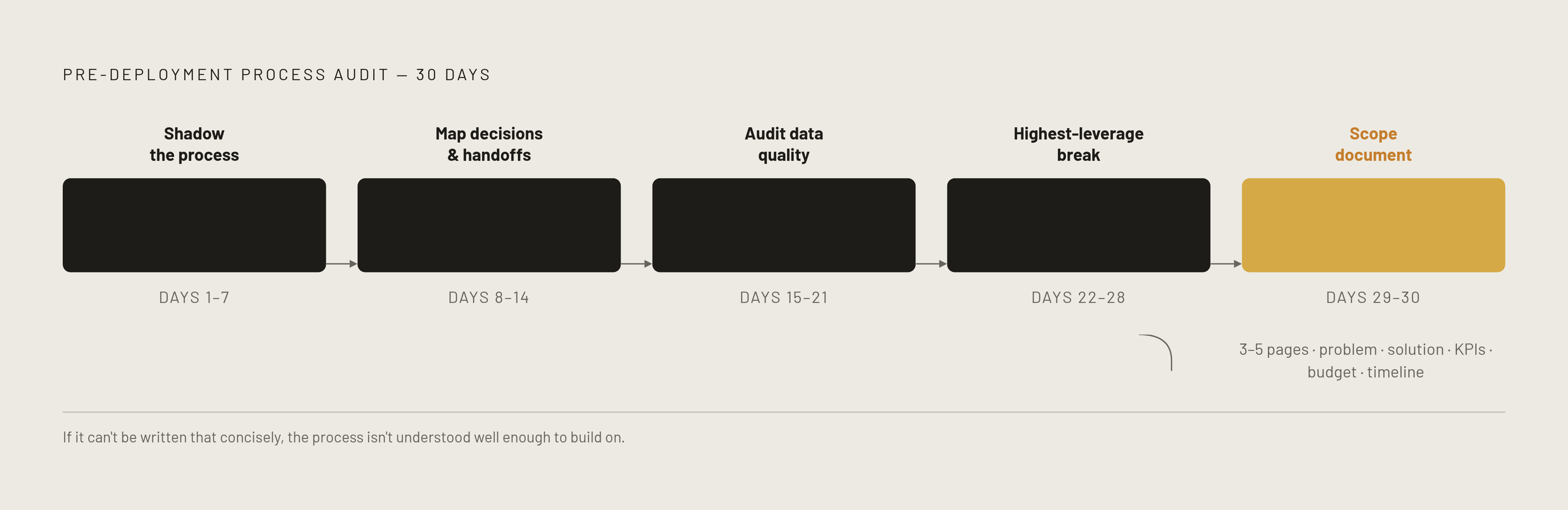
The first 30 days of a pre-deployment process audit have one goal: produce a scope document that is honest about where the process breaks and specific about what rebuilding it requires. It is not a vendor evaluation, a platform strategy, or a transformation roadmap.
A workable sequence runs across five stages. In days 1 through 7, shadow the process as it actually runs rather than as it's documented, having operations staff walk through how work moves through the system today, where they intervene manually, and where they've learned to expect failure. In days 8 through 14, map every decision point and handoff against the three audit layers: cross-system data flow, decision authority and triggers, and end-to-end observability, flagging every point where the honest answer to "what happens when this fails?" is "someone figures it out." In days 15 through 21, audit data quality at each system boundary, confirming whether the data an agent would read is current, complete, and field-validated rather than merely present in the system, checking procurement delivery dates, progress percentages, punch-list status, and controls interface assignments against what's actually happening on site. In days 22 through 28, identify the single most painful, highest-leverage process break, the one where a rebuilt workflow would produce the clearest measurable improvement, as the starting point for deployment. In days 29 and 30, produce the scope document itself: problem definition, proposed solution, KPIs tied to operational outcomes, budget, and timeline. If that document can't be written in three to five pages, the process hasn't been understood well enough yet to build an agent on top of it.
The starting point for any of this work is always a specific, painful process, never a platform strategy or a sweeping transformation roadmap, and that distinction is what separates genuine operational rebuilding from technology theater.
If the audit takes longer than 30 days to produce a scope document, either the scope is too broad or access to the process is insufficient, and you need to solve both before you make any deployment decision.