Why Asset-Heavy Companies Audit One Painful Process Before Any Platform Conversation Starts
Auditing one broken process first shows which AI tools you need.
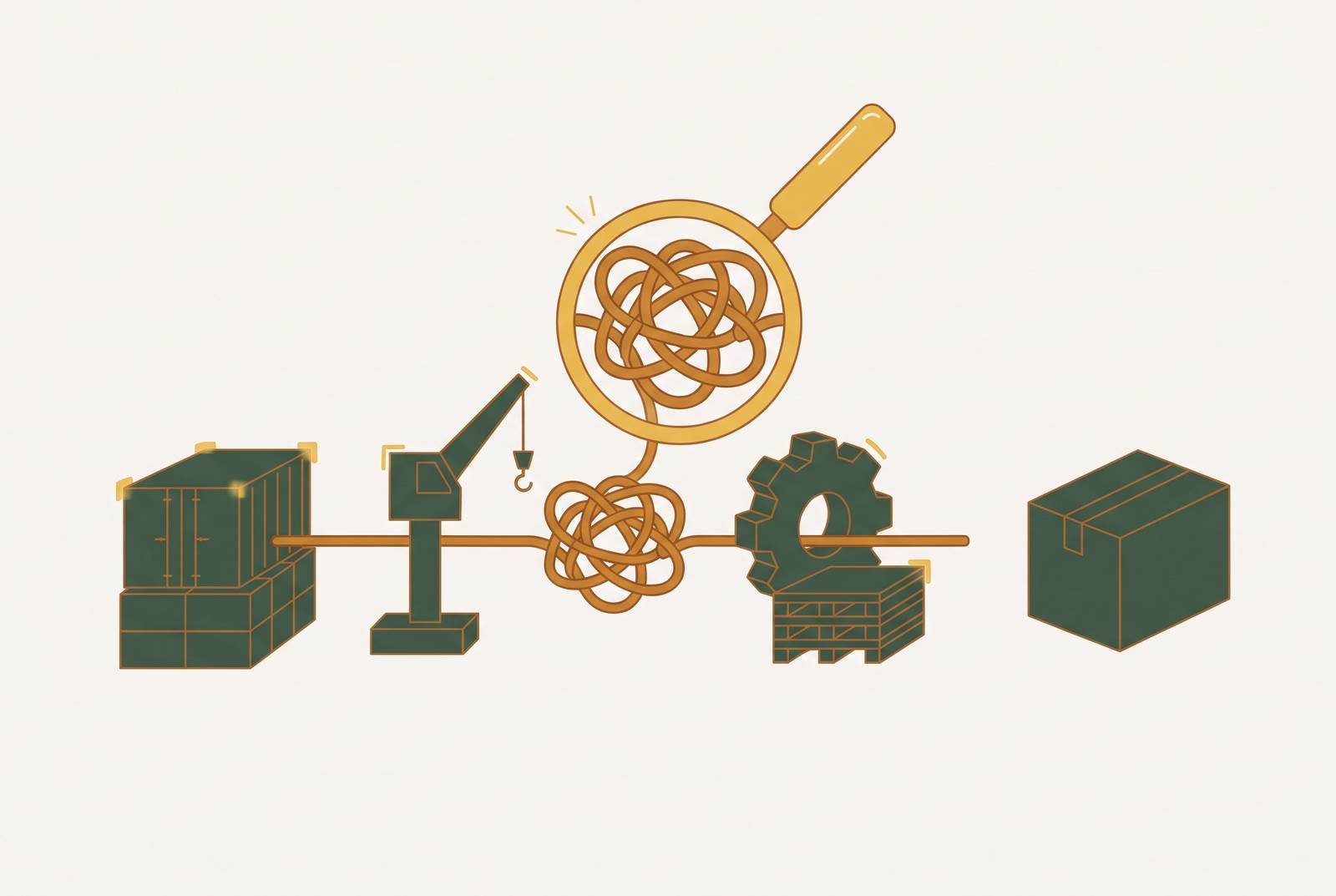
Asset-heavy companies can start using AI to improve how they work by auditing one painful process first, without an enterprise platform strategy. The audit establishes how work actually runs, what must change, and which tools the rebuilt workflow requires. The technology decision depends on the audit to produce a working operation without automating a broken one.
Why most asset-heavy AI efforts fail before the platform is ever chosen
Operations teams describe work as it is designed, while production exposes how it runs under pressure. The official procedure leaves out the manual overrides, records that disagree, and gaps in how people work together that set those versions apart. A platform selected against that procedure inherits an impossible assignment. It must perform on top of conditions it cannot fix. In construction, logistics, manufacturing, and retail, this is a process failure before it becomes a technology failure.
The mismatch often remains hidden during a pilot. Demo environments have clean, curated data, whereas live operations have inconsistent cost codes and manual exception handling. Construction projects may have no single master schedule, standard cost codes, clean RFI and submittal timestamps, or change events tied to the work breakdown structure. Logistics operations face incomplete TMS records, unreliable GPS capture, and improperly tracked inventory. In manufacturing, individual tasks are automated within systems, but people still do the work that links them in cross-system workflows. Successful task automation does not establish that the whole process is ready for AI.
What a process audit actually surfaces that a platform evaluation cannot
A platform evaluation tests what a vendor’s tools can do against the process as described. A process audit checks that description against how people do the work. It follows where people enter data, which fields they skip, and which records they reconcile after the fact. It also identifies steps that happen only because a particular person remembers to perform them. Those informal owners and undocumented exception paths are absent from an evaluation built around presentations and stated requirements.
An agent may need permissions that extend beyond the task as originally described, and that gap can compound when several agents participate in a workflow. The audit therefore examines more than the intended action. It establishes the operating conditions around that action, including the handoffs and exceptions on which its completion depends.
The Stanford Enterprise AI Playbook describes a semiconductor manufacturer whose field service engineers had to gather technical information from five or six repositories that different teams owned before they could begin diagnosis. Product specifications, test libraries, data sheets, and engineering logs were scattered across those repositories. Diagnosis was waiting on data gathering. After a redesign using a multi-agent framework, gathering that took more than forty hours dropped to under one hour. The useful requirement emerged from mapping the work.
A constrained pilot can also expose failure modes quickly. That is a legitimate alternative when the subprocess is truly isolated and low-stakes. However, procurement lock-in, energization dependencies, and safety implications make experimentation on a live asset-heavy workflow different from testing a standalone application. A failed pilot can disrupt downstream commitments that cannot easily be unwound. The painful process is often the most connected one, so auditing it and experimenting on it are not interchangeable choices.
How do you choose one broken plant process to start with?
The process everyone in the room knows is broken should take priority over the one that scores highest on a prioritization matrix. People closest to a visibly failing process have reasons to explain its defects. They can identify the workaround, the missing information, and the point at which the official procedure stops being useful. Their testimony supplies the audit’s raw material. A tolerably functioning process is more likely to attract a defense of existing arrangements than a clear account of their weaknesses.
The practical instruction is to demonstrate the work. Operations leaders should show, step by step, how the process runs today and where it hurts. For a cross-system manufacturing workflow, that means tracing how data flows, where handoffs happen, and how people handle exceptions by hand. A description may present an automated task as complete, while the demonstration reveals the manual coordination needed before the next task can begin. That difference is an audit finding.
Visible damage also creates permission to reconsider the workflow. When people already accept that a process is failing, redesign is easier to justify than it is in a process they regard as adequate. The risks of running the live workflow remain even with that permission. It makes the organization more willing to change the current procedure to address their cause.
Scope keeps this willingness actionable. An entire department’s process audit can take quarters, while an audit of one specific painful process can be live in weeks. The constraint is deliberate. It allows the team to establish how one workflow operates without waiting for a comprehensive map of the business.
How the audit changes what gets built and what gets discarded before any platform is selected
The audit’s output is a process specification. Before that specification exists, platform selection tends to become a comparison of features that may or may not fit the work. Afterward, teams can test what the tools can do against the exception paths, data conditions, and handoffs recorded in the specification. The evaluation now has an operational reference point. A platform must fit the process that will be built.
The audit may establish that the workflow needs a rebuild rather than automation, so configuring the existing sequence more efficiently would preserve its defects. It may also show that the data conditions behind a platform’s performance claims do not exist in production. In that case, the missing prerequisite is a change to the process that produces and maintains the data.
A connection described as standard may still need custom exception handling for more exceptions than the platform can handle. That requirement is difficult to recognize when exceptions are undocumented or treated as incidental. Once the audit exposes their role, some otherwise attractive platforms are disqualified on process fit. Other proposed automation steps disappear because the redesigned workflow no longer needs them.
The resulting platform conversation is narrower and more useful. It concerns the capabilities needed for a defined operation, rather than the broadest collection available for purchase. The audit gives platform evaluation a basis for rejecting unnecessary functionality and identifying requirements that a demonstration could not establish.
What regulatory requirements in 2026 now enforce that the audit produces documented evidence, not just findings
In regulated deployment, a process specification must also establish how the operation will produce evidence. Findings alone cannot show what an AI system acted on or whether a control worked as designed. The 2026 regulatory environment makes that distinction consequential for internal controls and procurement. Documentation becomes part of deployment.
COSO’s February 2026 guidance on generative AI and internal controls calls for a complete audit trail capturing prompts, inputs, outputs, model and configuration versions, and evidence of human review. Those records must support reconstruction of the action and demonstrate that the control functioned as designed. The SEC’s March 2026 announcement of a dedicated SOX enforcement group that targets audit firm misconduct adds pressure to enforce the rules for internal control over financial reporting. Guidance and enforcement serve different functions. Together, they make unsupported claims that an AI-touched control is working inadequate.
Attribution is a particularly difficult operational gap. An AI system may access regulated data through a service account or API key without recording who told it to do so. Where the respective regimes apply, that absence conflicts with HIPAA’s unique user identification rule, GDPR’s accountability principle, and SOX’s audit trail requirements. Keeping records longer does not show who acted if that was never recorded. The workflow must establish the connection between the individual and the action.
For construction and energy procurement, the consequence is direct. Procurement officers require audit trails showing a clear lineage of logic, and solutions unable to produce that documentation can remain in a sandbox despite technical performance. When audit trails and production monitoring are built into the deployment workflow, the work itself produces evidence. Waiting until review requires reconstruction of history instead, and the missing record can itself become a finding. The audit is where this distinction becomes a design requirement.
What the process audit reveals about organizational readiness that no technology assessment can
Even a workflow that clears the documentation bar can fail if nobody has the authority to sustain it. Organizational readiness is a separate question from whether the system can produce evidence. The audit exposes whether cross-department coordination is formal or depends on personal relationships. It also reveals whether the people who understand the painful process have the standing to redesign it. People who understand the work but lack permission to change it cannot act on what they find.
Ownership must extend to individual process steps. When several roles share responsibility but no owner is named, no one may have to answer for the quality of the work or its results. People who know each other can keep the work moving and hide that lack of an owner. Agents that work across departments reveal this weakness because the rebuilt workflow relies on those same handoffs. A budget approval or a technology assessment does not settle who is responsible when they fail.
A manufacturing supplier communication agent worked at launch but gradually degraded because the organizational process for maintaining its context had never been established. The model had not changed. The organization had treated the agent as static software rather than a process participant requiring ongoing management. An audit that identifies launch requirements without identifying ongoing ownership leaves this failure mode intact.
IHL Group’s research on retail technology outcomes found that edge computing currency was the single strongest predictor of AI outcomes. That finding concerns infrastructure readiness rather than platform selection, but it reinforces the need to establish operating conditions before commitment. The process audit connects those conditions to actual work. It can reveal whether the infrastructure, coordination, and ownership required by a rebuilt process exist together, rather than treating each as a separate assessment that never reaches the workflow.
How the audit produces the starting condition for an AI-first process, not just a diagnosis of the current one
A completed audit defines a first process that is ready to be rebuilt. Its specification is narrow enough to be buildable in weeks, reflects actual data quality and exception rates, and identifies an owner with the knowledge and standing to validate the result. These are starting conditions. They establish what can be built and who can judge whether it works.
The redesign then treats AI agents as participants in the workflow. Their role is defined within the process, including its real coordination dependencies and exception paths. Tool selection follows that design. Teams then ask which tools support the specified workflow, giving less weight to which platform has the most features. An enterprise software strategy is not required to answer that narrower question.
Speed provides a useful diagnostic once the audit is complete. If the first AI-first process cannot go live within weeks, the scope may still be too broad or the platform conversation may have started too early. A roadmap that promises more will not solve either problem. The practical test is whether the operations team can explain, step by step, how the rebuilt process will run and what it will produce. It is too early to choose a platform without that testable specification.
The six-month comparison therefore concerns operational results. A company that starts with the audit has a defined workflow against which to assess deployment and outcomes, with ownership and evidence requirements established before tool selection. A company that starts with a platform may still be discovering the process conditions its purchase assumed. The audit creates the conditions for fast deployment whose results can be demonstrated.