Rebuilding Department Workflows From Zero Means Designing for Agent Handoffs Not Human Ones
Successful AI workflows require explicit handoff contracts, not just passing context between agents.
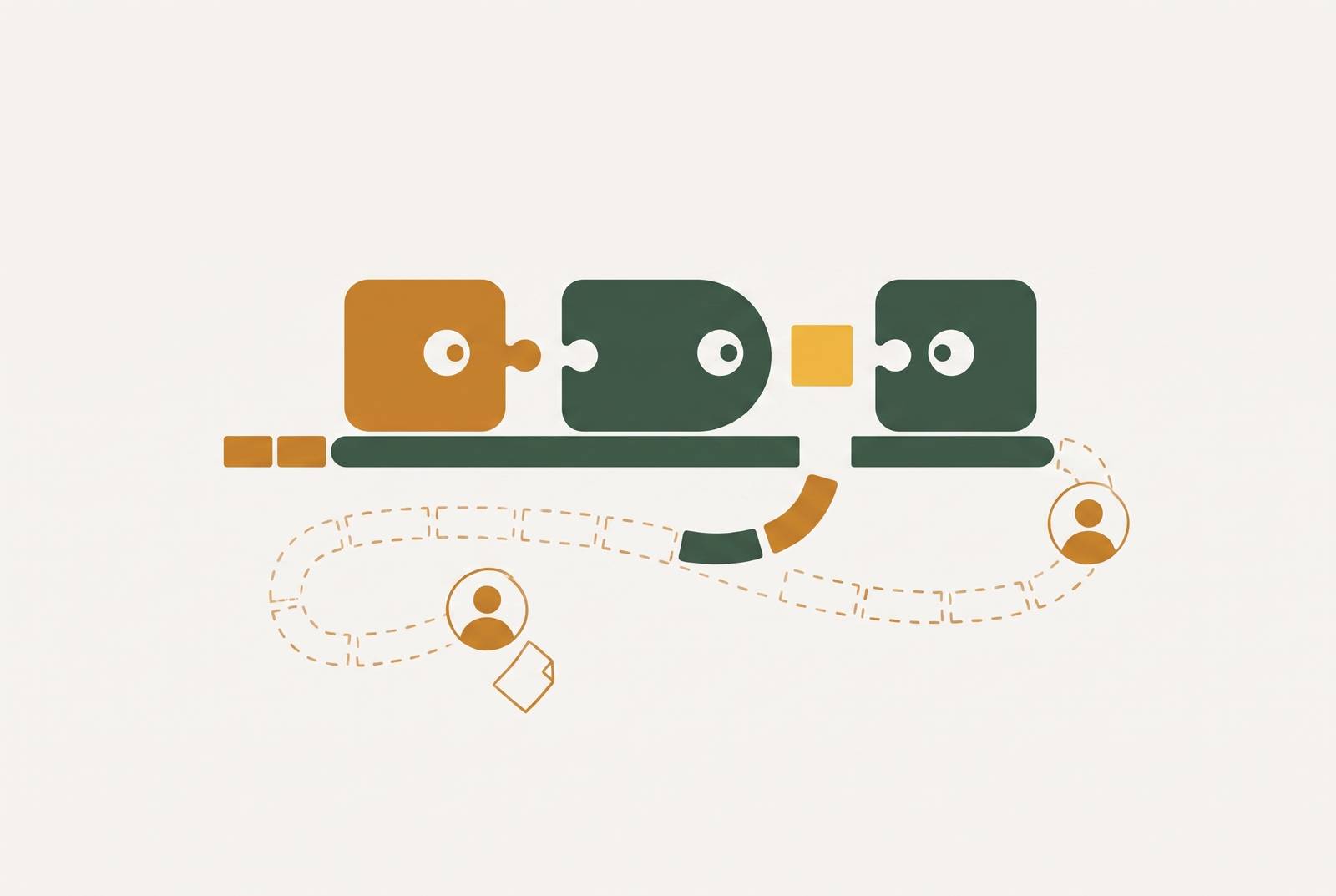
To rebuild department workflows with AI agents from scratch, start with the outcome and design transfers that make the context, state, and obligations clear. Replacing people inside the existing workflow is not enough, because human handoffs depend on judgment and tacit knowledge that agents cannot reliably inherit. Design each transfer around what the successor must preserve, must not repeat, and must still complete.
Why most workflow redesigns for AI stall before the hard part
Automating its existing tasks leaves a more important question unanswered, namely whether each transfer contains enough information for an agent to continue correctly. The tasks may look ready for automation even when people still have to fill in gaps in the context. That dependency makes redesign harder because it spans task boundaries.
Deloitte's 2025 Emerging Technology Trends study found that just 11% of the organizations surveyed were using agentic systems in production, though many were exploring them and running pilots. Deloitte's agentic AI strategy research identifies a central failure pattern in attempts to automate processes designed for human workers without rethinking the work itself. The result can be more work. Its term agentic “workslop” describes that burden, while “agent washing” compounds the problem by presenting existing automation as agentic AI even where simpler tools would suffice.
What makes human handoffs work — and why that logic breaks for agents
Human handoffs often succeed despite incomplete documentation. The receiver can ask a clarifying question, recall a prior conversation, or judge what the sender meant by “done.” Those recovery mechanisms allow organizations to operate with instructions that would be inadequate on their own. A process map may show a clean transfer even when the work relies on what the people on each side know. The human workflow includes that unwritten contribution.
An agent operates on the context available to it, so accepted choices, completed actions, and unfinished obligations must survive the transfer explicitly. Past conversation alone may not make those categories clear. If the successor cannot tell which decisions are fixed and which work remains open, it may restart completed work or treat an unfinished request as complete. The failure lies in the transfer contract.
Research on stateful agent handoffs describes this boundary as the “commitment frontier.” Its invoice example involves a payment that has been confirmed and executed while receipt delivery remains pending. The successor cannot charge again, switch to a different invoice, or declare success before delivery. The request is “neither fresh nor complete.” This is the essential distinction between remembering what happened and knowing what remains binding.
Existing agent components address only parts of that distinction. Routing and memory can pass context without specifying what the successor must preserve and finish. A planner can propose further actions, but its proposal cannot reveal the obligations it has omitted. Action-level guards can reject an unsafe call without detecting a required action that was never proposed. None alone defines the unfinished work at the boundary.
The five structural failure modes that emerge when agents hand off to other agents
Governance gaps arise when a task moves without the policy context that governs it. The receiving agent may act outside policy because the applicable constraints were absent from the handoff.
Transparency gaps leave reviewers unable to reconstruct an agent's actions. The transfer lacks the audit trail needed to explain what happened across the workflow.
Coordination gaps appear when agents work from unsynchronized state. Each may proceed from a different account of what has already been decided or completed.
Safety gaps let untrusted content cross into trusted reasoning. One agent's output can contaminate the next agent's decisions when the handoff fails to preserve that boundary.
Plateaued improvement occurs when better models stop improving the deployment. The workflow architecture limits what the models can do, so upgrades leave the flaws in the transfers in place.
These categories provide a diagnostic vocabulary to support examination of the process. Agents that pass work back and forth without a clear duty to stop can create infinite loops. Agents treating one another's output as validated truth can produce hallucinated consensus, while dependence on shared tools or data can produce resource deadlock. Because these failures arise both within and between agents, standard testing of individual actions does not establish that the whole chain preserves its obligations.
The “sandbox trap” describes agents losing reliability when they leave controlled environments and encounter organizational data. Missing context can then become context hallucination, with agents fabricating metrics, policies, or business rules to fill the gap. In that setting, the defect is architectural rather than simply a model limitation, because the workflow has not supplied the context required for the decision.
Why governance applied uniformly across agents makes both problems worse
Gartner's analysis identifies a binary governance trap in treating agents as either locked down or fully trusted. Over-restricting simple agents slows delivery and encourages shadow development outside the governance framework. Under-restricting autonomous agents creates operational, security, and compliance risk, especially where they can write to production systems. Uniform controls are therefore not a neutral compromise. They can constrain low-stakes work while leaving consequential actions insufficiently controlled.
At a handoff, that mismatch becomes concrete. An agent receiving a task without its governing policy context cannot establish which constraints apply merely because the organization has a general AI policy. Monitoring cannot supply an instruction missing at the point of action. The design response is differentiated governance based on scope of action, reversibility of outputs, and data sensitivity. Those criteria connect the controls to the work the agent can actually perform.
The Integrator Advantage framework makes owners, audit logs, access rights, monitoring, and kill switches mandatory and assigns them per agent. Least privilege gives that approach a precise boundary. Each agent needs an explicit identity and access scoped to its task, rather than permissions inherited from the broader system or a predecessor. Transferring responsibility for work must not imply transferring unrestricted authority to act.
What "making context explicit" actually requires at a handoff point
The Commitment-Frontier Residual Completion framework, or CFRC, sets three rules for how work should carry on across a handoff. Target-before-proposal requires the successor to know what it is completing before proposing an action. Whole-proposal-before-authority requires the full remainder to be checked before any action is executed. Live-evidence-before-success requires live receipts to show that all open obligations have been met before an agent claims success.
The handoff must therefore distinguish three kinds of state. It must identify what has been accepted and is now fixed, what has been executed and cannot safely be repeated, and what remains open and must be completed. In the invoice case, those distinctions preserve the selected invoice and executed payment while retaining receipt delivery as an obligation. A transcript must make those boundaries usable by the successor.
CFRC also connects handoff quality to deployment economics. The framework achieves comparable accuracy to strong full-task agents at a fraction of the cost by using lower-cost models for routine steps and transferring control when tasks become difficult. That result depends on explicit commitment state. Escalation is useful only when the receiving agent can continue directly from accepted progress.
Process mapping gives that state a basis in how the work runs. Level 1 defines outcome and scope, Level 2 defines ownership, decision rights, and escalations, and Level 3 defines operational context, including systems and data dependencies. Each level answers a different design question. Without an explicit Level 2, agents inherit unresolved roles and decisions from the legacy workflow. Without Level 3, they lack the execution context they need to tell completed work from open work.
The Parallax framework builds a boundary between reasoning and execution into the structure of the system. It argues that prompt-level guardrails are insufficient because they share the same computational substrate as the threats they attempt to mitigate. In a multi-agent chain, prompt injection can propagate across subsequent layers, making the separation of trusted authority from incoming content a requirement of handoff design.
Data architecture supplies the remaining prerequisite, which is access to the context the transfer requires. A 2025 Deloitte survey found that 48% of organizations cited data searchability as a challenge to their AI automation strategy. Deloitte's strategy analysis points to enterprise search and indexing that contextualizes data through knowledge graphs, making it discoverable without extensive ETL. Retrieval supports the handoff but does not replace it. The agent still needs to know which retrieved information governs accepted choices, executed effects, and outstanding obligations.
How this plays out differently in construction, manufacturing, and logistics
Construction procurement exposes the problem in document reconciliation. Agents handling three-way matching across quotes, purchase orders, delivery tickets, and invoices need to know which documents have been reconciled, which discrepancies remain open, and which have been resolved. Without that state, they can repeat checks or miss mismatches. A Suffolk and MIT white paper finds that real gains in construction require several workflows to change together, rather than one more tool being bolted onto the process already in place.
Manufacturing makes the transfer between prediction and action especially important. Maintenance is shifting from fixed schedules toward predictive models responding to actual machine behavior, while quality control is moving from detecting finished defects toward identifying precursor process conditions. Both changes depend on explicit operational state. Deloitte's 2026 manufacturing survey prescribes end-to-end process augmentation connecting prediction, recommendation, action, and continuous learning. Each connection introduces a handoff where an observation, a proposed response, and an executed action must remain distinguishable.
For logistics, the same test applies wherever agents detect disruptions and reroute work. A proposed change is not an executed change. The handoff requirement is to distinguish the accepted decision, any action already taken, and the work still open, rather than expecting the successor to infer status from a recommendation. Delivery tickets also connect logistics activity to procurement reconciliation, so a transfer must preserve whether a discrepancy is unresolved or already settled. The sector changes the operational context, but not the need to encode completion explicitly.
How do you rebuild a department workflow with AI agents rather than patch it?
A genuine rebuild starts with the outcome, then defines roles, decisions, and handoffs before selecting workflow tools. A patch starts with the existing task sequence and inserts agents into it. The order is decisive. Applying BPM and workflow tools before intent is clear is a sequencing failure that documents noise and produces brittle processes that are difficult to change and rarely adopted.
One practical signal of redesign is a reduction in actors, decision points, and handoffs. The reduction comes from resolving ambiguity into explicit state and decision rules. Fewer transfers also mean fewer boundaries at which context can be lost. Deloitte's strategy research associates value with redesigned operations, agent-compatible architectures, robust orchestration, and new management approaches for digital workers.
The Integrator Advantage framework identifies a bridge between process understanding, system interfaces, identity and access management, AI evaluation, governance, and workforce enablement. Model access is not the scarce capability here. For an organization assessing implementation help, those capabilities provide a more relevant basis for judgment than the promise to automate an existing sequence. The work is to embed a model safely into an operating process.
The starting point should therefore be a specific, painful process and an audit of how it runs today. That audit establishes where the process hurts, what to rebuild first, and what each handoff must contain. A broad platform strategy cannot answer those questions. With narrow scope and transfer requirements defined before automation begins, a first live workflow should be operational in weeks. Long timelines are a signal to examine whether the effort is rebuilding a bounded process or still patching its inherited complexity.