Scoring Your Construction Workflows by Breakage Before Any AI Vendor Gets a Seat at the Table
Audit your workflows for structural breaks before any AI tool can reliably improve them.
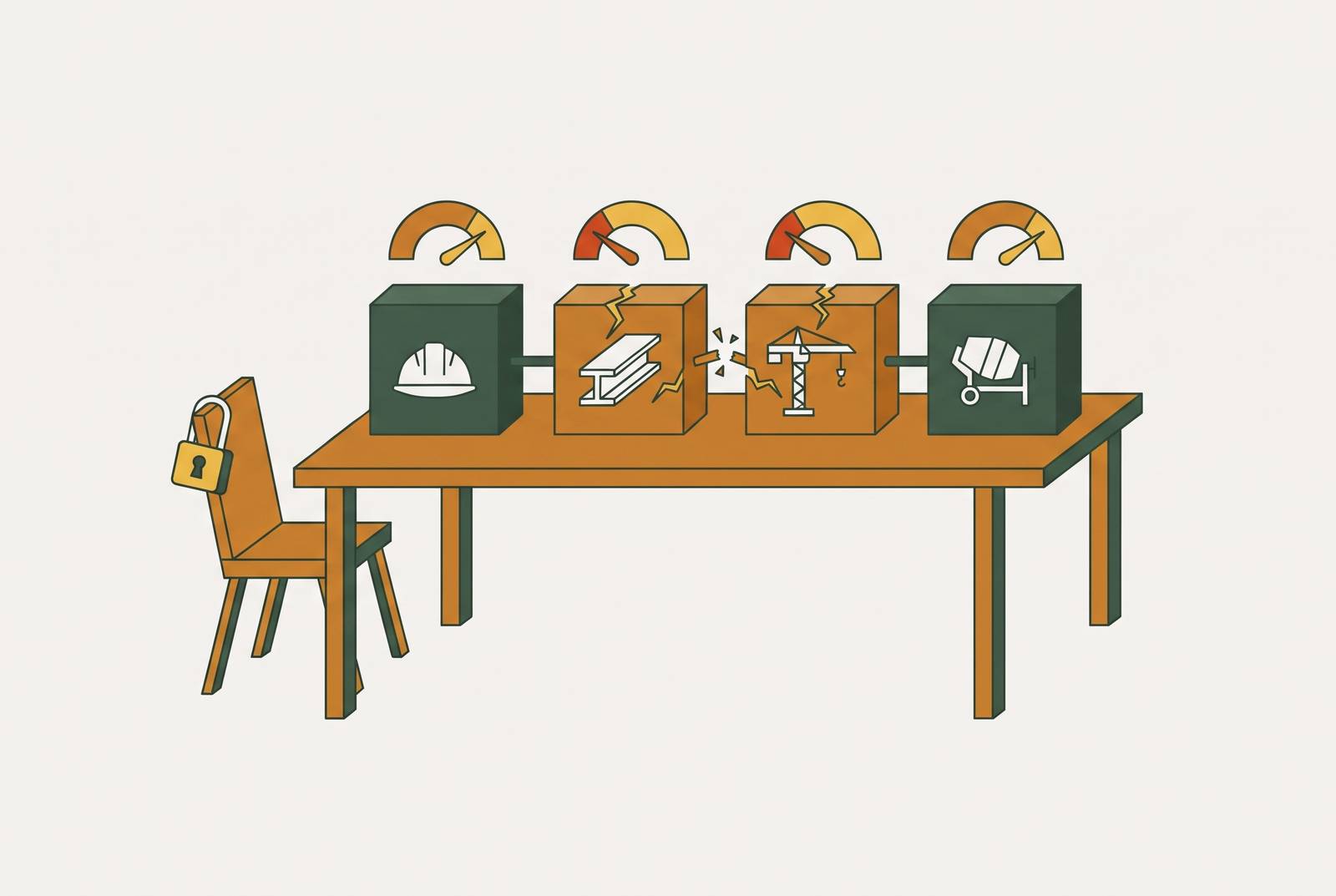
Before deploying AI in construction or logistics operations, teams should audit how work actually moves through evidence, handoffs, exceptions, and decisions. Scoring construction workflows by breakage establishes where a process needs rebuilding before automation can help. The deciding factor is not whether a workflow can accept an AI tool, but whether its records and controls are sound enough for that tool to improve outcomes.
Why the standard vendor evaluation sequence gets construction AI backwards
A vendor demo leads to a promising pilot, and an internal champion presses for a platform decision. The sequence feels concrete because there is something to evaluate. The demonstration establishes capability while leaving the operation’s failures undiagnosed. Without that diagnosis, the buyer can compare features but cannot tell whether they fix what makes the work unreliable.
Suffolk and MIT’s September 2026 white paper modelled six AI-enabled levers against a project that was already complete and found that changing several workflows together cut the schedule by 22–25%. A tool bolted onto a process as it stands offers much less benefit because the work around it still depends on the same things. The workflow is what the buyer needs to evaluate.
That shifts the initial focus to which workflow needs rebuilding and whether that rebuild would improve adjacent processes, before deciding which platform to buy. An operations leader must establish that internally before asking a vendor to propose an approach. Otherwise, the vendor’s capabilities define the problem instead of the operation’s failures defining the requirements.
What "breakage" actually means in a construction workflow
Breakage is the structural condition that makes a workflow unreliable under load, difficult for managers to see accurately, and dangerous to automate. It is not the same as failure. A broken workflow may produce acceptable outputs until conditions change, handoffs accumulate, or exceptions arrive. A workflow can also handle high volume or complex work without breakage. The distinction is whether the process remains dependable when the work becomes difficult.
Evidence gaps arise when the declared state differs from the actual state. A submittal log can look current while the underlying work is weeks behind, just as a schedule baseline can stop reflecting procurement reality. The record illustrates the gap between having a policy and operating a control.
Handoff failures arise when information does not reach the next team in a usable form. Procurement decisions fragmented across tools, inboxes, and disconnected spreadsheets illustrate the problem. Exception accumulation is different again, because the routine path works while unusual cases are settled informally and leave no recoverable record. Eventually, the workaround becomes the normal route through the process.
Construction incentives can conceal all three conditions. Project managers get rewarded for moving work forward and solving problems but get no reward for documentation, so fixing what is in the way may leave gaps in the record of how decisions were made. An audit, handover, or claim then forces the team to reconstruct what happened.
Why automating a broken construction workflow accelerates the damage
AI operates on the data it receives. If those inputs describe a declared state rather than an actual state, its outputs inherit that gap. Poor logic, links, and constraints in a baseline schedule at award leave the site team reacting throughout the job. Scheduling AI cannot compensate for inputs that never represented a sound plan, while verifying its outputs adds work that the deployment decision must account for.
Procurement exposes the same mechanism through downstream dependencies. Without real-time tracking, teams cannot tell whether materials will arrive when needed, whether they need substitutions, or how delays will affect the work that follows. An AI layer can produce faster answers from an incomplete account of supply, while labor plans and trade sequences continue to depend on those answers.
Avison Young’s 2026 High Court loss involved an £8.7 million award linked to over-certification on the Buckingham Group Coventry earthworks project. The evidence problem had two distinct parts. The project manager accepted lower baseline volume estimates without asking enough questions and also used excavation figures in place of records of material placed in its final position. These were failures in the basis for certification. Automating certification without correcting that basis would have accelerated the same overpayment mechanism.
Post-deployment monitoring is not a substitute for repairing that foundation. Monitoring catches errors after they propagate, when downstream trades, procurement releases, and payment schedules may already be moving on the output. Recovery can then cost more than correcting the original error under the manual process. The audit must therefore identify both unreliable inputs and the decisions that would amplify them.
The four dimensions that determine how badly a workflow is broken
Evidence integrity asks whether records show what happened or just what someone said happened. The practical signal is reconstruction difficulty. If existing records cannot establish the decision sequence after the event, integrity is low. For progress verification, the relevant gap is between what a superintendent declares complete and what is photographically, spatially, and contractually verified.
Handoff fidelity asks whether information reaches the next team or system on time, with all the details and in a form it can use. Manual translation is the diagnostic signal here. Every change of format, system, or owner can introduce a point where information must be re-entered or interpreted. Procurement status held in email rather than a system the scheduler can read exposes this weakness even when both teams maintain their own records diligently.
Exception density asks how often work leaves its defined path and whether those departures remain controlled. The signal is the share of cases requiring a workaround, side conversation, or decision outside the documented process. Small departures can form a persistent pattern. Fragmented uploads, inconsistent naming, delayed inspections, and disconnected approval trails may appear manageable individually while making the overall workflow difficult to reconstruct.
Decision lag asks how much time passes between something happening and someone with the authority to act doing something about it. Progress confirmed weeks after execution leaves the decision-maker working from outdated information. That delay is structural. It also interacts with evidence integrity, because late verification of unreliable evidence combines uncertainty about what happened with a reduced opportunity to respond. The dimensions form a profile because their interaction is more revealing than any single label.
How do you score workflow breakage before deploying AI?
To run the audit, an operations leader should ask the team to show exactly how the process runs today and where it hurts. The documented procedure is not the starting point. Use the actual sequence followed by the last three instances, including departures from the expected route. The people who perform the work supply the operational account, while the records establish how much of that account the process preserves. A whiteboard and two hours provide a practical setting for the walkthrough.
For evidence integrity, pull three recent completed instances and attempt to reconstruct the full decision sequence from records alone. Score integrity High when reconstruction is complete and unambiguous, Medium when one or two clarifying conversations resolve gaps, and Low when reconstruction takes significant effort or becomes impossible in places. For payment certification, progress sign-off, and compliance verification, check that the record identifies both the evidence reviewed and the decision made.
For handoff fidelity, map every point where information changes format, system, or owner, and count the manual translations. Score fidelity High when information moves without manual re-entry or reformatting. Score it Medium when one or two translations exist but are standardized, and Low when email is the primary handoff mechanism or downstream teams regularly receive incomplete information. The scheduling-procurement handoff is a particularly useful check. Establish whether the scheduler can see current procurement status or must rely on the last meeting’s summary.
For exception density, ask the team to describe the last five occasions when the workflow did not go as expected. Listen for a defined path to resolution. Score density Low when exceptions follow a recorded escalation path, Medium when handling is consistent but informal, and High when exceptions are routine or most scenario answers depend on circumstances. Review the last month of document submissions as a supporting check. Inconsistent naming, format, or timing is a useful proxy for uncontrolled departures from the process.
For decision lag, establish two intervals at each major decision point. Measure the time from the condition arising to the decision, then separately from the decision to downstream action. Score lag Low when both gaps are measured in hours or a small number of days, Medium when they extend from days to one week, and High when they are measured in weeks or the team cannot establish them. Retain the four labels as separate scores. A workflow with Low evidence integrity, High exception density, and High decision lag needs to be rebuilt before AI is brought in.
Which workflows to prioritize when multiple processes are broken
The most broken workflow is not automatically the first priority. A workflow with medium breakage that feeds five downstream processes may need work before one that is badly broken but self-contained. For each candidate, identify what cannot happen reliably until it produces a correct output. The longer that dependency chain, the greater the consequence of leaving its breakage unresolved.
The scheduling-procurement link commonly exposes this concentration of risk. If the schedule does not reflect procurement status, downstream labor plans, trade sequences, and cash flow projections are based on something that is not true. When Critical-path activities drop off the weekly schedule list, they give an early sign that the link is already broken.
Rebuildability is the second test of where to start. Low exception density makes a high-consequence workflow more tractable because the team has fewer informal branches to resolve. AI agents are best suited to repeatable, high-volume, data-rich work, although they are not the same as fixed rule-based automation. Their ability to adapt does not remove the need to understand exceptions. High exception density should therefore constrain prioritization rather than simply increase a workflow’s apparent urgency.
A good workflow to start with has medium evidence integrity problems, low exception density, and a high-consequence downstream dependency. That combination offers scope for a visible improvement quickly enough to build confidence in the next rebuild. The process target is Level 3 in the workflow maturity model, where procedures are documented, approval chains are defined, routing is standardized, and email is no longer the primary coordination tool. This is where AI readiness begins.
What the breakage profile tells you that a vendor's readiness assessment cannot
A vendor’s readiness assessment asks whether a workflow can accept its tool. A breakage profile asks whether AI would improve the workflow’s outcomes. The data at hand can be wrong, work that looks easy to automate can have many exceptions, and a fast process can hide delays in making decisions. These are distinctions an internal audit must make before a product assessment begins.
The assessments differ in scope independently of vendor competence. A readiness assessment is designed around fit with a particular platform, so it naturally emphasizes the conditions that permit deployment. The breakage profile supplies the operational constraints that this frame can miss. It allows the buyer to identify a specific evidence gap, describe the exception pattern, and ask the vendor to demonstrate how its approach handles both.
For operations leaders, the audit identifies one painful process where rebuilding can produce a live result within weeks. The immediate action is to run the walkthrough on one process this week, record its four-dimension breakage profile, and identify the downstream work that depends on it. Do that before scheduling the vendor call.